EE-102 Engineering Mathematics-I Mar-Apr 2026 paper solved: matrix inversion, circle and conic, maxima and minima
 Nookesh Karri ·· 21 min read

This post solves the AP SBTET C-23 Engineering Mathematics 1 question paper of March 2026 (EE-102, March/April 2026), the common first year paper that DEEE students also write. Every question is here: all 10 Part A questions and all 8 Part B questions, each worked step by step with the method the C-23 syllabus teaches. You can open the original EE-102 question paper PDF side by side and check each answer.
Engineering Mathematics 1 question paper March 2026: pattern and syllabus units
The EE-102 paper has two parts and a total of 80 marks in 3 hours. Part A has 10 questions of 3 marks each (30 marks), and you must answer all of them. Part B has 8 questions of 10 marks each, and you answer any 5 (50 marks). The units below come from the C-23 DEEE curriculum.
| Q no | Topic | Syllabus unit | Marks |
|---|---|---|---|
| 1 | Domain and range of 1/x | Unit I: Functions | 3 |
| 2 | Partial fractions | Unit I: Partial fractions | 3 |
| 3 | 2A − B | Unit I: Matrices | 3 |
| 4 | Determinant of a 2 × 2 matrix | Unit I: Matrices and determinants | 3 |
| 5 | cos(A − B) | Unit II: Compound angles | 3 |
| 6 | sin 2A from tan A | Unit II: Multiple angles | 3 |
| 7 | Inverse of 2 − 3i | Unit II: Complex numbers | 3 |
| 8 | Line through two points | Unit III: Straight lines | 3 |
| 9 | lim sin 3x / x | Unit IV: Limits | 3 |
| 10 | Derivative of x³ + eˣ | Unit IV: Differentiation | 3 |
| 11 | Matrix inversion method | Unit I: Matrices | 10 |
| 12 | Transformations; inverse trigonometric functions | Unit II | 5 + 5 |
| 13 | Trigonometric equation; solving a triangle | Unit II | 5 + 5 |
| 14 | Circle through three points; conic from focus and directrix | Unit III | 5 + 5 |
| 15 | Product rule; chain rule | Unit IV: Differentiation | 5 + 5 |
| 16 | Parametric derivative; partial derivatives | Unit IV: Differentiation | 5 + 5 |
| 17 | Tangent and normal; rate of change | Unit V: Applications | 5 + 5 |
| 18 | Maxima and minima; errors and approximations | Unit V: Applications | 5 + 5 |
For more papers of this subject, see the Engineering Mathematics-I papers page.
Q1. Find the domain and range of the real function f(x) = 1/x. (3 marks)
The function f(x) = 1/x is defined for every real x except x = 0, because division by zero is not defined.
- Domain: all real numbers except 0, that is R − {0}.
- For range, put y = 1/x. Then x = 1/y.
- x is a real number for every y except y = 0. Also 1/x can never be 0.
- Range: R − {0}.
Answer: Domain = R − {0}, Range = R − {0}.
Q2. Resolve 1/((x − 5)(x − 3)) into partial fractions. (3 marks)
The denominator has two different linear factors, so each factor gets one constant numerator.
- Let 1/((x − 5)(x − 3)) = A/(x − 5) + B/(x − 3).
- Multiply by (x − 5)(x − 3): 1 = A(x − 3) + B(x − 5).
- Put x = 5: 1 = A(2), so A = 1/2.
- Put x = 3: 1 = B(−2), so B = −1/2.
Answer: 1/((x − 5)(x − 3)) = 1/(2(x − 5)) − 1/(2(x − 3)).
Q3. If A = [1 3 −1; 2 8 5] and B = [1 0 2; 1 −4 −1], then find 2A − B. (3 marks)
Both matrices are of order 2 × 3, so 2A − B is defined. Multiply every element of A by 2, then subtract the matching element of B. (The text copy of the paper loses the minus signs; the PDF shows −1 in A and −4, −1 in B.)
Step 1: 2A
| Col 1 | Col 2 | Col 3 | |
|---|---|---|---|
| Row 1 | 2 | 6 | −2 |
| Row 2 | 4 | 16 | 10 |
Step 2: 2A − B = [2 − 1, 6 − 0, −2 − 2; 4 − 1, 16 − (−4), 10 − (−1)]
| Col 1 | Col 2 | Col 3 | |
|---|---|---|---|
| Row 1 | 1 | 6 | −4 |
| Row 2 | 3 | 20 | 11 |
Answer: 2A − B = [1 6 −4; 3 20 11].
Q4. Find the determinant of the matrix [2 1; 1 −5]. (3 marks)
For a 2 × 2 matrix [a b; c d], the determinant is ad − bc.
- a = 2, b = 1, c = 1, d = −5.
- |A| = (2)(−5) − (1)(1)
- = −10 − 1
Answer: |A| = −11.
Q5. Show that cos100° cos40° + sin100° sin40° = 1/2. (3 marks)
The left side has the form of the compound angle formula cos(A − B) = cos A cos B + sin A sin B.
- Take A = 100° and B = 40°.
- LHS = cos(100° − 40°)
- = cos 60°
- = 1/2 = RHS.
Answer: cos100° cos40° + sin100° sin40° = cos 60° = 1/2. Hence proved.
Q6. If tan A = 3/4, then find the value of sin 2A. (3 marks)
The multiple angle formula sin 2A = 2 tan A / (1 + tan²A) uses tan A directly, so you do not need sin A and cos A separately.
- tan²A = 9/16, so 1 + tan²A = 25/16.
- 2 tan A = 2 × 3/4 = 3/2.
- sin 2A = (3/2) ÷ (25/16) = (3/2) × (16/25) = 24/25.
Check: with sin A = 3/5 and cos A = 4/5, sin 2A = 2 × 3/5 × 4/5 = 24/25.
Answer: sin 2A = 24/25.
Q7. Find the multiplicative inverse of the complex number (2 − 3i). (3 marks)
The multiplicative inverse of z is 1/z. Multiply the top and bottom by the conjugate to make the denominator real.
- 1/(2 − 3i) = (2 + 3i) / ((2 − 3i)(2 + 3i))
- Denominator = 2² − (3i)² = 4 + 9 = 13.
- 1/(2 − 3i) = (2 + 3i)/13.
Answer: Multiplicative inverse = 2/13 + (3/13)i.
Q8. Find the equation of the straight line passing through the points (2,3) and (5,6). (3 marks)
Use the two-point form (y − y₁)/(y₂ − y₁) = (x − x₁)/(x₂ − x₁).
- (x₁, y₁) = (2, 3), (x₂, y₂) = (5, 6).
- (y − 3)/(6 − 3) = (x − 2)/(5 − 2)
- (y − 3)/3 = (x − 2)/3
- y − 3 = x − 2
Answer: x − y + 1 = 0 (slope 1).
Q9. Evaluate lim (x→0) sin 3x / x. (3 marks)
Use the standard limit lim (θ→0) sin θ / θ = 1.
- sin 3x / x = 3 × (sin 3x / 3x).
- As x → 0, 3x → 0.
- Limit = 3 × lim (3x→0) sin 3x / 3x = 3 × 1.
Answer: lim (x→0) sin 3x / x = 3.
Q10. Find the derivative of x³ + eˣ w.r.t. x. (3 marks)
The derivative of a sum is the sum of the derivatives.
- d/dx (x³) = 3x² (power rule, d/dx xⁿ = n xⁿ⁻¹).
- d/dx (eˣ) = eˣ.
Answer: d/dx (x³ + eˣ) = 3x² + eˣ.
Q11. Solve the system of linear equations x − y + 3z = 5, 4x + 2y − z = 0 and −x + 3y + z = 5 using matrix inversion method. (10 marks)
In the matrix inversion method you write the system as AX = D and find X = A⁻¹D, where A⁻¹ = (adj A)/|A|.
Step 1: Write the system in matrix form AX = D.
| A | Col x | Col y | Col z | D |
|---|---|---|---|---|
| Row 1 | 1 | −1 | 3 | 5 |
| Row 2 | 4 | 2 | −1 | 0 |
| Row 3 | −1 | 3 | 1 | 5 |
X = [x; y; z].
Step 2: Find |A| (expand along the first row).
- |A| = 1[(2)(1) − (−1)(3)] − (−1)[(4)(1) − (−1)(−1)] + 3[(4)(3) − (2)(−1)]
- = 1(2 + 3) + 1(4 − 1) + 3(12 + 2)
- = 5 + 3 + 42
- = 50
|A| = 50 ≠ 0, so A is non-singular and A⁻¹ exists.
Step 3: Find the cofactors Aᵢⱼ = (−1)ⁱ⁺ʲ × minor.
- A₁₁ = +[(2)(1) − (−1)(3)] = 5
- A₁₂ = −[(4)(1) − (−1)(−1)] = −3
- A₁₃ = +[(4)(3) − (2)(−1)] = 14
- A₂₁ = −[(−1)(1) − (3)(3)] = 10
- A₂₂ = +[(1)(1) − (3)(−1)] = 4
- A₂₃ = −[(1)(3) − (−1)(−1)] = −2
- A₃₁ = +[(−1)(−1) − (3)(2)] = −5
- A₃₂ = −[(1)(−1) − (3)(4)] = 13
- A₃₃ = +[(1)(2) − (−1)(4)] = 6
Step 4: adj A is the transpose of the cofactor matrix.
| adj A | Col 1 | Col 2 | Col 3 |
|---|---|---|---|
| Row 1 | 5 | 10 | −5 |
| Row 2 | −3 | 4 | 13 |
| Row 3 | 14 | −2 | 6 |
So A⁻¹ = (1/50) adj A.
Step 5: X = A⁻¹D = (1/50)(adj A)(D).
- Row 1: 5(5) + 10(0) + (−5)(5) = 25 + 0 − 25 = 0
- Row 2: (−3)(5) + 4(0) + 13(5) = −15 + 0 + 65 = 50
- Row 3: 14(5) + (−2)(0) + 6(5) = 70 + 0 + 30 = 100
- X = (1/50)[0; 50; 100] = [0; 1; 2]
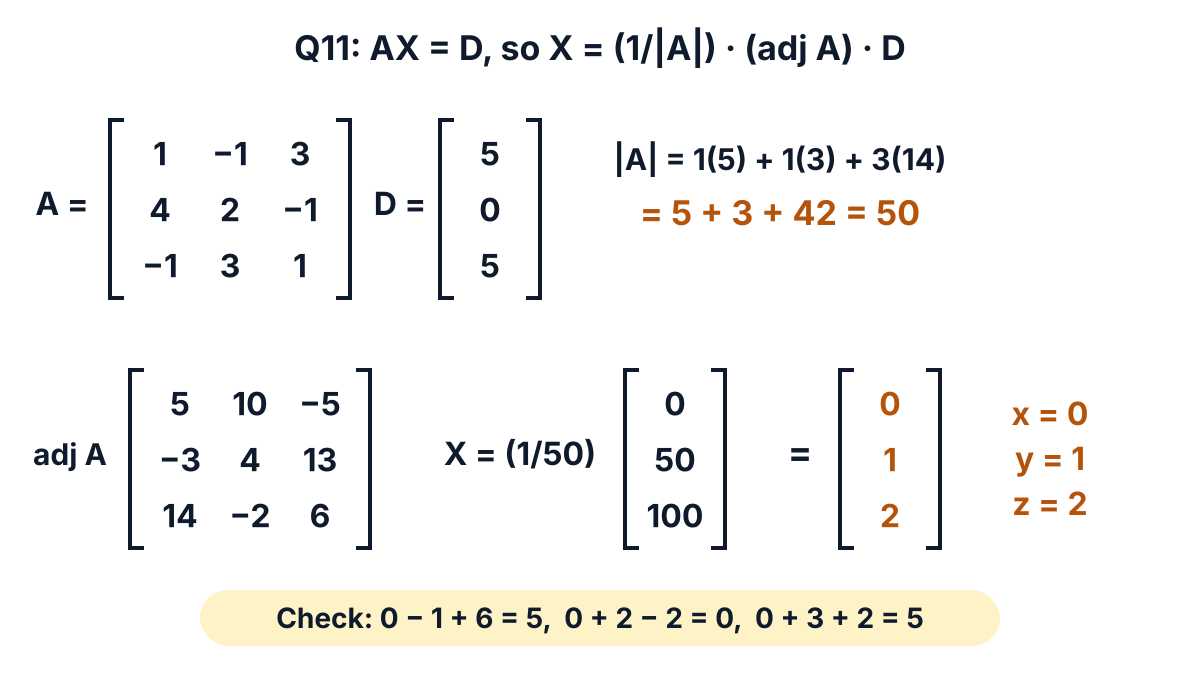
Figure: the whole matrix inversion on one page; check the adjoint rows before you multiply.
Step 6: Check in all three equations.
- x − y + 3z = 0 − 1 + 6 = 5 ✓
- 4x + 2y − z = 0 + 2 − 2 = 0 ✓
- −x + 3y + z = 0 + 3 + 2 = 5 ✓
Answer: x = 0, y = 1, z = 2.
Exam tip: adj A is the transpose of the cofactor matrix. If you forget to transpose, you get a wrong X even when every cofactor is right. Always check your answer in all three equations.
Q12. (a) Prove that cos θ + cos(120° + θ) + cos(120° − θ) = 0. (b) Prove that tan⁻¹(1/2) − tan⁻¹(1/5) = tan⁻¹(3/11). (10 marks)
Part (a) uses the transformation formula cos C + cos D, and part (b) uses the difference formula of inverse tangents. Each part carries 5 marks.
(a) 5 marks
Formula: cos C + cos D = 2 cos((C + D)/2) cos((C − D)/2).
- Take C = 120° + θ and D = 120° − θ.
- (C + D)/2 = 240°/2 = 120°.
- (C − D)/2 = 2θ/2 = θ.
- cos(120° + θ) + cos(120° − θ) = 2 cos 120° cos θ.
- cos 120° = −1/2, so this = 2(−1/2) cos θ = −cos θ.
- LHS = cos θ + (−cos θ) = 0 = RHS.
Hence proved.
(b) 5 marks
Formula: tan⁻¹x − tan⁻¹y = tan⁻¹[(x − y)/(1 + xy)], for xy > −1.
- x = 1/2, y = 1/5, and xy = 1/10 > −1.
- x − y = 1/2 − 1/5 = 3/10.
- 1 + xy = 1 + 1/10 = 11/10.
- (x − y)/(1 + xy) = (3/10) ÷ (11/10) = 3/11.
- So tan⁻¹(1/2) − tan⁻¹(1/5) = tan⁻¹(3/11) = RHS.
Hence proved.
Key points to write: (a) cos(120° + θ) + cos(120° − θ) = −cos θ; (b) (1/2 − 1/5)/(1 + 1/10) = 3/11.
Q13. (a) Solve √3 cos θ − sin θ = 1. (b) Solve triangle ABC with a = 1, b = √2, c = 1. (10 marks)
Part (a) is an equation of the type a cos θ + b sin θ = c, solved by dividing by √(a² + b²). Part (b) uses the cosine rule. Each part carries 5 marks.
(a) 5 marks
- Here a = √3, b = −1, so √(a² + b²) = √(3 + 1) = 2.
- Divide by 2: (√3/2) cos θ − (1/2) sin θ = 1/2.
- Write √3/2 = cos(π/6) and 1/2 = sin(π/6).
- cos θ cos(π/6) − sin θ sin(π/6) = 1/2
- cos(θ + π/6) = 1/2 = cos(π/3).
- General solution of cos x = cos α is x = 2nπ ± α.
- θ + π/6 = 2nπ ± π/3.
- With +: θ = 2nπ + π/3 − π/6 = 2nπ + π/6.
- With −: θ = 2nπ − π/3 − π/6 = 2nπ − π/2.
Check: θ = π/6 gives √3(√3/2) − 1/2 = 3/2 − 1/2 = 1 ✓.
Answer (a): θ = 2nπ + π/6 or θ = 2nπ − π/2, where n is any integer.
(b) 5 marks
Solving a triangle means finding all three angles when the three sides are given. Use the cosine rule.
- cos A = (b² + c² − a²)/(2bc) = (2 + 1 − 1)/(2 × √2 × 1) = 2/(2√2) = 1/√2.
- So A = 45°.
- cos B = (c² + a² − b²)/(2ca) = (1 + 1 − 2)/(2 × 1 × 1) = 0.
- So B = 90°.
- C = 180° − (A + B) = 180° − 135° = 45°.
- Check: a = c, so A = C, which matches.
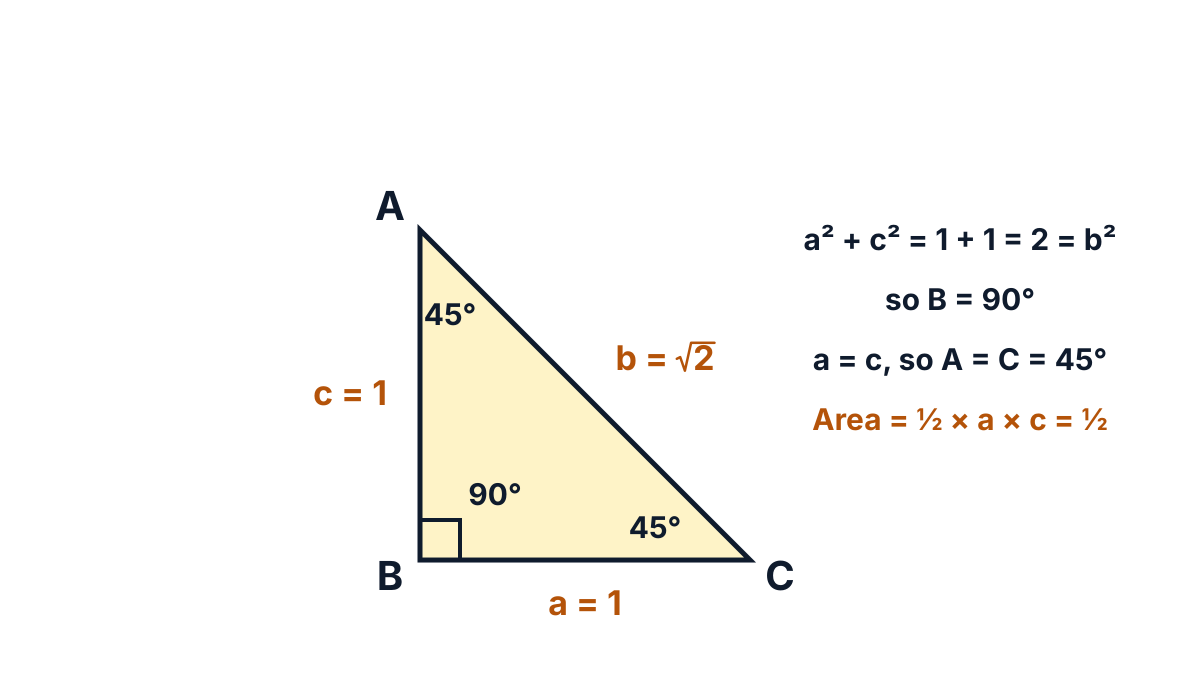
Figure: a² + c² = b², so the triangle is right-angled at B and isosceles.
Answer (b): A = 45°, B = 90°, C = 45° (area = ½ × a × c × sin B = ½ square unit).
Q14. (a) Find the equation of the circle passing through the points (0,0), (2,0) and (0,−3). (b) Find the equation of the conic whose focus is (1,−2), eccentricity 1/√2 and directrix is 3x − 2y + 1 = 0. (10 marks)
Part (a) is the circle through three points of the type (0,0), (a,0), (0,b), which the syllabus names. Part (b) uses the focus-directrix definition of a conic, SP = e × PM. Each part carries 5 marks.
(a) 5 marks
- Let the circle be x² + y² + 2gx + 2fy + c = 0.
- Through (0, 0): c = 0.
- Through (2, 0): 4 + 4g = 0, so g = −1.
- Through (0, −3): 9 − 6f = 0, so f = 3/2.
- Equation: x² + y² − 2x + 3y = 0.
Short check with the standard result: the circle through (0,0), (a,0), (0,b) is x² + y² − ax − by = 0. Here a = 2 and b = −3, which gives the same equation.
Centre = (−g, −f) = (1, −3/2). Radius = √(g² + f² − c) = √(1 + 9/4) = √13/2.
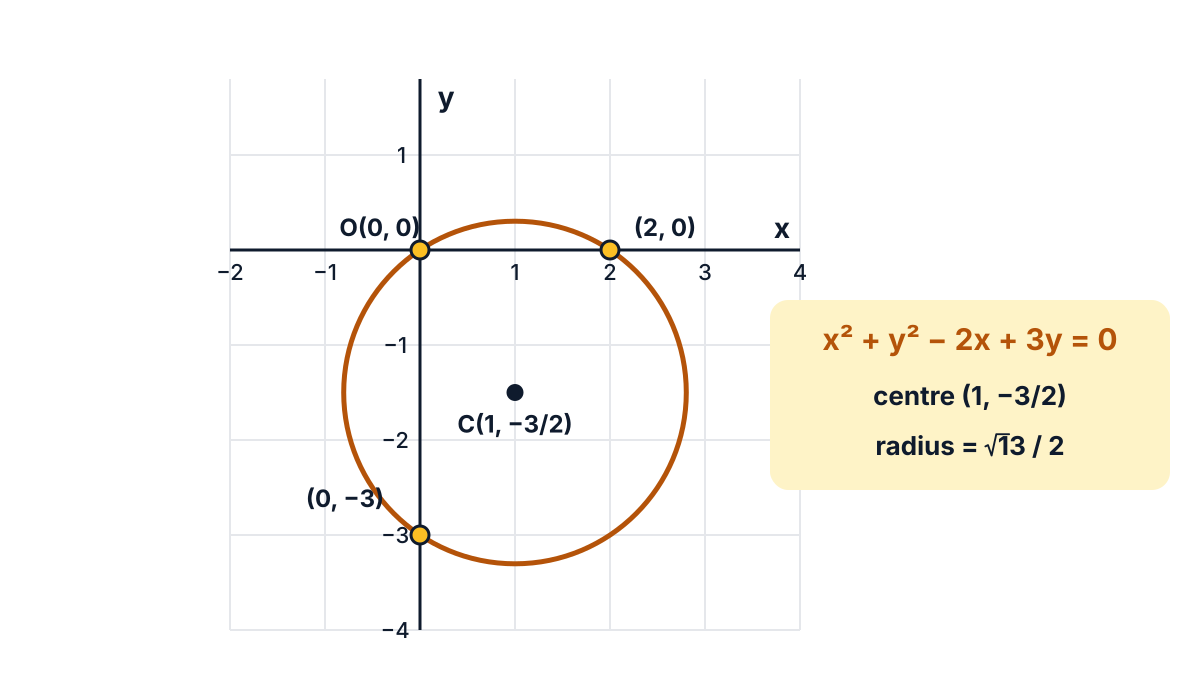
Figure: the three given points lie on the circle; the centre is the midpoint of (2,0) and (0,−3).
Answer (a): x² + y² − 2x + 3y = 0.
(b) 5 marks
Let P(x, y) be any point on the conic, S(1, −2) the focus and PM the perpendicular distance from P to the directrix.
- Definition: SP/PM = e, so SP² = e² × PM².
- SP² = (x − 1)² + (y + 2)².
- PM = |3x − 2y + 1| / √(3² + 2²) = |3x − 2y + 1| / √13, so PM² = (3x − 2y + 1)²/13.
- e² = 1/2.
- (x − 1)² + (y + 2)² = (1/2) × (3x − 2y + 1)²/13.
- Multiply by 26: 26[(x − 1)² + (y + 2)²] = (3x − 2y + 1)².
- LHS = 26(x² − 2x + 1 + y² + 4y + 4) = 26x² + 26y² − 52x + 104y + 130.
- RHS = 9x² + 4y² + 1 − 12xy + 6x − 4y.
- LHS − RHS = 0: 17x² + 12xy + 22y² − 58x + 108y + 129 = 0.
Since e = 1/√2 < 1, the conic is an ellipse.
Answer (b): 17x² + 12xy + 22y² − 58x + 108y + 129 = 0 (an ellipse).
Exam tip: square e before you use it. Here e² = 1/2, not 1/√2. Also watch the sign in the cross term: −(−12xy) becomes +12xy.
Q15. (a) Find the derivative of x² sin x with respect to x. (b) Find the derivative of √(tan 3x) with respect to x. (10 marks)
Part (a) needs the product rule and part (b) needs the chain rule. Each part carries 5 marks.
(a) 5 marks
Product rule: d/dx (uv) = u (dv/dx) + v (du/dx).
- u = x², v = sin x.
- du/dx = 2x, dv/dx = cos x.
- d/dx (x² sin x) = x² cos x + sin x × 2x.
Answer (a): d/dx (x² sin x) = 2x sin x + x² cos x.
(b) 5 marks
Chain rule: if y = f(u) and u = g(x), then dy/dx = (dy/du)(du/dx).
- Let y = √(tan 3x) = (tan 3x)^(1/2).
- dy/dx = (1/2)(tan 3x)^(−1/2) × d/dx (tan 3x).
- d/dx (tan 3x) = sec²3x × d/dx (3x) = 3 sec²3x.
- dy/dx = (1/2) × 3 sec²3x / √(tan 3x).
Answer (b): d/dx √(tan 3x) = 3 sec²3x / (2√(tan 3x)).
Q16. (a) If x = ct and y = c/t, then find dy/dx. (b) If u(x,y) = log(x + y), then prove that x ∂u/∂x + y ∂u/∂y = 1. (10 marks)
Part (a) is a parametric derivative, dy/dx = (dy/dt)/(dx/dt). Part (b) needs the first order partial derivatives of u. Each part carries 5 marks.
(a) 5 marks
- x = ct, so dx/dt = c.
- y = c/t = c t⁻¹, so dy/dt = −c t⁻² = −c/t².
- dy/dx = (dy/dt)/(dx/dt) = (−c/t²)/c.
Answer (a): dy/dx = −1/t².
(b) 5 marks
- u = log(x + y).
- ∂u/∂x: treat y as a constant. ∂u/∂x = 1/(x + y) × ∂/∂x (x + y) = 1/(x + y).
- ∂u/∂y: treat x as a constant. ∂u/∂y = 1/(x + y).
- x ∂u/∂x + y ∂u/∂y = x/(x + y) + y/(x + y)
- = (x + y)/(x + y) = 1 = RHS.
Hence proved.
Key points to write: ∂u/∂x = ∂u/∂y = 1/(x + y); then add x times one and y times the other.
Q17. (a) Find the equations of the tangent and normal to the curve y = x² + 2 at (0,2). (b) The side of square plate is expanding at the rate 0.3 cm/sec. Find the rate at which its perimeter is increasing when its side is 10 cm. (10 marks)
Part (a) uses the slope of the tangent, m = dy/dx at the point. Part (b) uses the derivative as a rate measure. Each part carries 5 marks.
(a) 5 marks
- y = x² + 2, so dy/dx = 2x.
- At (0, 2): m = 2(0) = 0.
- Tangent: y − y₁ = m(x − x₁), so y − 2 = 0(x − 0), that is y = 2.
- The slope of the normal is −1/m. With m = 0 the normal is vertical.
- A vertical line through (0, 2) is x = 0.
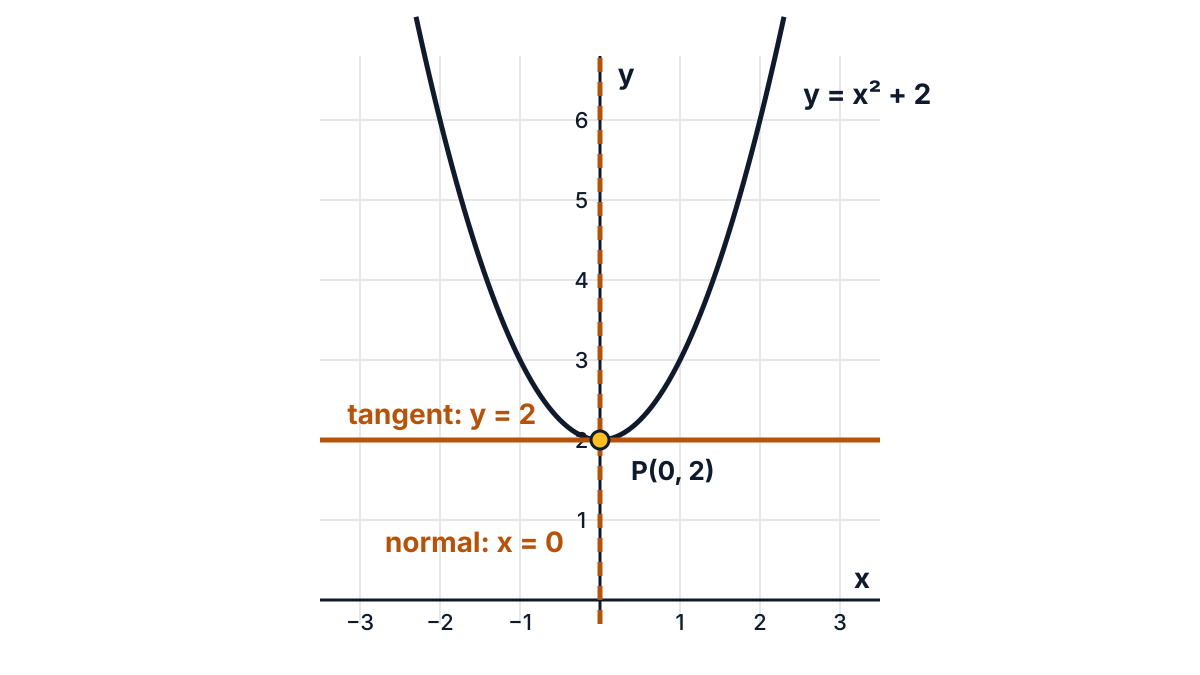
Figure: at the lowest point of the curve the tangent is horizontal, so the normal is the y-axis.
Answer (a): Tangent y = 2 (y − 2 = 0); Normal x = 0.
(b) 5 marks
- Let the side be x cm. Given dx/dt = 0.3 cm/sec.
- Perimeter P = 4x.
- dP/dt = 4 × dx/dt = 4 × 0.3 = 1.2 cm/sec.
- dP/dt does not depend on x, so at side 10 cm it is still 1.2 cm/sec.
Answer (b): The perimeter increases at 1.2 cm/sec.
Exam tip: students often use the 10 cm in the answer. For the perimeter of a square it is not needed; it would be needed only for the area (dA/dt = 2x dx/dt).
Q18. (a) Find the maximum or minimum value of the function f(x) = 2x² − 3x + 5. (b) Compute Δy if y = x³ − 2x, x = 3 and Δx = 0.001. (10 marks)
Part (a) uses the first and second derivative test. Part (b) uses the change in y for a small change in x, from the errors and approximations unit. Each part carries 5 marks.
(a) 5 marks
- f(x) = 2x² − 3x + 5.
- f′(x) = 4x − 3.
- For a turning point, f′(x) = 0: 4x − 3 = 0, so x = 3/4.
- f″(x) = 4 > 0, so f has a minimum at x = 3/4.
- Minimum value f(3/4) = 2(9/16) − 3(3/4) + 5 = 9/8 − 18/8 + 40/8 = 31/8.
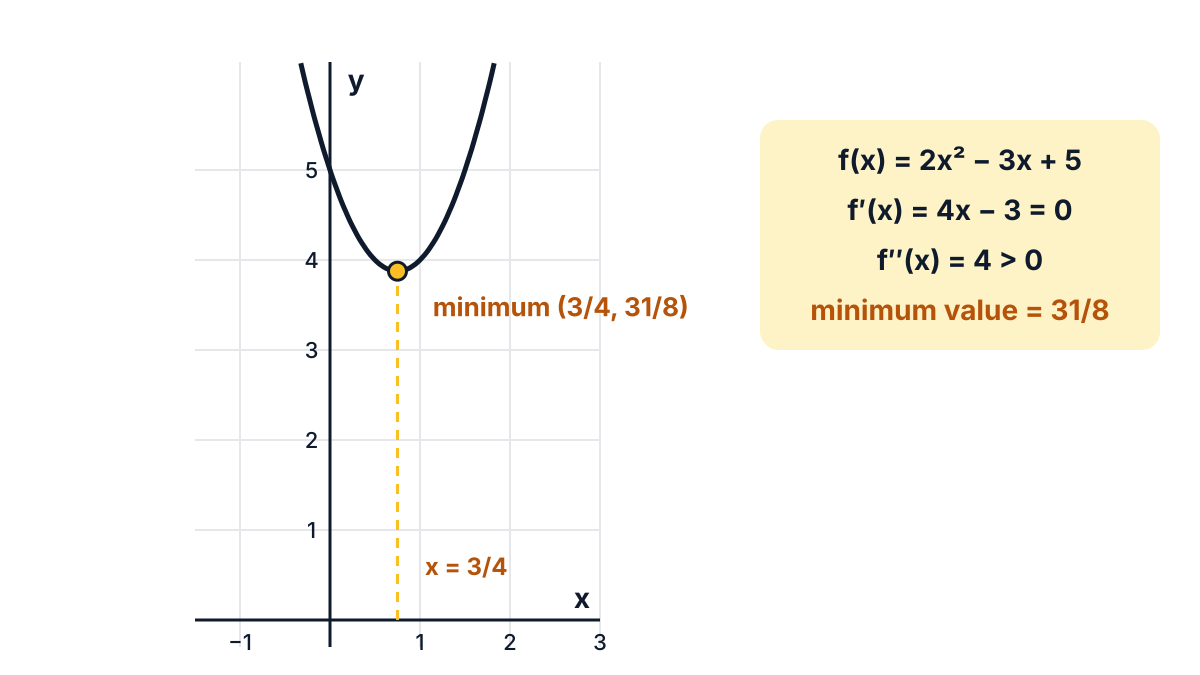
Figure: the parabola opens upward, so it has a minimum and no maximum.
Answer (a): Minimum value 31/8 (= 3.875) at x = 3/4. There is no maximum.
(b) 5 marks
Δy is the change in y when x changes from x to x + Δx.
- y(3) = 3³ − 2(3) = 27 − 6 = 21.
- y(3.001) = (3.001)³ − 2(3.001) = 27.027009001 − 6.002 = 21.025009001.
- Δy = y(3.001) − y(3) = 21.025009001 − 21 = 0.025009001.
Approximation method of the syllabus: Δy ≈ dy = f′(x) Δx.
- f′(x) = 3x² − 2, so f′(3) = 27 − 2 = 25.
- dy = 25 × 0.001 = 0.025.
Answer (b): Δy = 0.025009001, and by approximation Δy ≈ dy = 0.025.
My advice: if you are short of time, pick Q11, Q15, Q16, Q17 and Q18. The four calculus questions are short, and Q11 scores full marks once the cofactors are right. Skip Q14(b) unless you have practised squaring PM², because one sign slip there costs most of the part.
FAQ
Which units carry the most marks in the EE-102 March 2026 paper?
Unit II Trigonometry and Unit IV Differential Calculus. Trigonometry gives Part A questions Q5, Q6 and Q7 and two full Part B questions (Q12, Q13). Calculus gives Q9, Q10 and two Part B questions (Q15, Q16).
Which Part B questions are the easiest to score in this paper?
Q15, Q16, Q17 and Q18 are short calculus sums with one or two lines of working each. Q11 (matrix inversion) is long but fully mechanical, so it is safe if you practise cofactors.
Is Q18(b) asking for the exact change or the approximate change?
It says “Compute Δy”. The exact change is 0.025009001. The errors and approximations method of the syllabus gives Δy ≈ f′(x)Δx = 0.025. Write both lines; they take less than a minute.
Are these the official SBTET answers?
No. These are model answers worked out from the C-23 syllabus methods and checked with python. They are not SBTET’s official key, and this site is not affiliated with SBTET AP.
Sources
- AP SBTET C-23 DEEE EE-102 question paper, Mar-Apr 2026
- C-23 Curriculum, Diploma in Electrical and Electronics Engineering, SBTET AP
- Prescribed textbook: Engineering Mathematics-I, textbook for first year diploma courses, prepared and prescribed by SBTET AP
- Reference books (C-23 syllabus):
- Shanti Narayan: A Textbook of Matrices, S. Chand
- Moyer & Ayres: Schaum’s Outline of Trigonometry, 4th ed.
- Thomas & Finney: Calculus and Analytic Geometry, 9th ed., Addison Wesley
- Ayres & Mendelson: Schaum’s Outline of Calculus
- M. Vygodsky: Mathematical Handbook, Mir Publishers
Writes and reviews the SBTET EEE Papers solutions: AP SBTET diploma question papers answered step by step from the prescribed syllabus.