EE-103 Engineering Physics Mar-Apr 2026 paper solved: Wheatstone bridge, ideal gas equation, photovoltaic cell
 Nookesh Karri ·· 28 min read

The EE-103 engineering physics question paper March 2026 is the C-23 first year common paper for AP SBTET diploma students, including DEEE. It has 10 short questions of 3 marks and 8 long questions of 10 marks, of which you answer any five. This post solves every question on the March/April 2026 question paper, with answers sized to the marks, labelled diagrams and every sum worked in SI units.
Engineering physics question paper March 2026: pattern and syllabus units
The engineering physics paper of March 2026 follows the usual C-23 pattern: Part A is 10 × 3 = 30 marks (answer all), Part B is 5 × 10 = 50 marks (answer any five of eight), 3 hours, 80 marks in total. The questions come from all eight chapters of the C-23 curriculum, and Gravitation gets two full Part B questions this time.
| Q no | Topic | Syllabus unit | Marks |
|---|---|---|---|
| 1 | Advantages of SI units | Unit 1: Units and measurements | 3 |
| 2 | Moment of force | Unit 2: Statics | 3 |
| 3 | KE when momentum doubles | Unit 4: Concepts of energy | 3 |
| 4 | Celsius to kelvin | Unit 5: Thermal physics | 3 |
| 5 | Musical sound and noise | Unit 6: Sound | 3 |
| 6 | Doppler effect applications | Unit 6: Sound | 3 |
| 7 | Ohm’s law | Unit 7: Electricity and Magnetism | 3 |
| 8 | Magnetic lines of force | Unit 7: Electricity and Magnetism | 3 |
| 9 | n-type semiconductor | Unit 8: Modern physics | 3 |
| 10 | Optical fibre applications | Unit 8: Modern physics | 3 |
| 11 | Triangle law; resolution of a force | Unit 2: Statics | 6 + 4 |
| 12 | Newton’s law of gravitation; sum | Unit 3: Gravitation | 6 + 4 |
| 13 | Relation between g and G; satellites | Unit 3: Gravitation | 5 + 5 |
| 14 | Conservation of energy; photovoltaic cell | Unit 4: Concepts of energy | 3 + 7 |
| 15 | Ideal gas equation; modes of heat transfer | Unit 5: Thermal physics | 7 + 3 |
| 16 | Noise pollution control; echo | Unit 6: Sound | 5 + 5 |
| 17 | Wheatstone bridge; sum | Unit 7: Electricity and Magnetism | 7 + 3 |
| 18 | Photoelectric effect; superconductors | Unit 8: Modern physics | 7 + 3 |
My advice: in Part B, pick Q17, Q12, Q11, Q15 and Q13 first. Each one is a standard derivation or law with a short sum. Keep Q16 or Q18 as a backup if one derivation does not come to you. You can find other EE-103 papers on the Engineering Physics subject page.
Q1. Write any three advantages of SI units. (3 marks)
The SI (International System of Units) is used worldwide for science and engineering. Its main advantages are:
- Coherent system: the unit of a derived quantity comes from the base units by multiplying or dividing, with no extra number. For example, 1 N = 1 kg × 1 m s⁻².
- Rational system: each physical quantity has only one unit (joule for all forms of energy, watt for all power).
- Decimal (metric) system: multiples and submultiples go in powers of 10, like kilo, milli and micro, so conversion is easy.
- International and complete: every country uses it, and it covers mechanics, heat, electricity, magnetism and light.
Key points to write: coherent, rational, metric (decimal), accepted all over the world.
Q2. Define moment of force. Write its SI unit. (3 marks)
The moment of force (torque) is the turning effect of a force about a point or axis. It equals the product of the force and the perpendicular distance from the axis to the line of action of the force.
Moment of force τ = F × d
Here F is the force in newton and d is the perpendicular distance in metre. The SI unit of moment of force is the newton metre (N m). Example: a spanner turns a nut more easily when you push at the far end of the handle, because d is larger.
Key points to write: τ = F × d, perpendicular distance, unit N m.
Q3. If the momentum of a body is doubled, how does its kinetic energy change? (3 marks)
Kinetic energy and momentum are related by KE = p² / 2m, where p = mv is the momentum and m is the mass.
- Initial kinetic energy: KE₁ = p² / 2m
- New momentum p₂ = 2p, mass unchanged.
- New kinetic energy: KE₂ = (2p)² / 2m = 4p² / 2m = 4 KE₁
So the kinetic energy becomes four times the original value. That is an increase of 300%.
Answer: KE becomes 4 times (KE ∝ p² for a fixed mass).
Q4. Convert 0 °C, −100 °C and 37 °C temperatures into degree Kelvin temperatures. (3 marks)
The printed paper reads −100 °C. Some text copies of this paper lose the minus sign, so check your own copy. The relation is T (K) = t (°C) + 273 (the exact value is 273.15).
| Celsius | Working | Kelvin |
|---|---|---|
| 0 °C | 0 + 273 | 273 K (273.15 K) |
| −100 °C | −100 + 273 | 173 K (173.15 K) |
| 37 °C | 37 + 273 | 310 K (310.15 K) |
Answer: 273 K, 173 K and 310 K. Kelvin temperatures have no degree sign, and they are never negative.
Exam tip: Write “K”, not “°K”. Many students lose a mark for that.
Q5. Distinguish between musical sound and noise. (3 marks)
A musical sound is pleasant to the ear, while noise is unpleasant.
| Musical sound | Noise |
|---|---|
| Pleasing effect on the ear | Unpleasant, irritating effect |
| Produced by regular, periodic vibrations | Produced by irregular, non-periodic vibrations |
| No sudden change in loudness | Sudden changes in loudness |
| Has a definite frequency (pitch) | Has no definite frequency |
| Example: veena, flute, tuning fork | Example: traffic horns, machines, a falling vessel |
Key points to write: regular vs irregular vibrations, pleasant vs unpleasant, definite vs no definite frequency.
Q6. Write any three applications of Doppler effect. (3 marks)
The Doppler effect is the apparent change in the frequency of a wave when the source and the observer move relative to each other. Its applications are:
- Traffic police radar measures the speed of vehicles from the change in frequency of the reflected waves.
- RADAR and SONAR find the speed of aircraft, ships and submarines.
- Medical Doppler ultrasound measures the speed of blood flow in arteries and the heartbeat of a baby in the womb.
- Astronomy finds whether a star or galaxy is moving towards or away from the earth (red shift).
- Weather radar tracks the motion of storms and clouds.
Key points to write: speed of vehicles, RADAR/SONAR, blood flow, stars.
Q7. State Ohm’s law and write its formula and name the terms in it. (3 marks)
Ohm’s law: at constant temperature (and other physical conditions), the current through a conductor is directly proportional to the potential difference across its ends.
V ∝ I, so V = I R
- V = potential difference across the conductor, in volt (V)
- I = current through the conductor, in ampere (A)
- R = resistance of the conductor, a constant, in ohm (Ω)
Example: if 2 A flows through a 5 Ω resistor, the voltage across it is V = 2 × 5 = 10 V. A graph of V against I is a straight line through the origin. Ohm’s law does not hold for devices such as diodes.
Q8. Write any three properties of magnetic lines of force. (3 marks)
A magnetic line of force is the path along which a free north pole would move in a magnetic field. Its properties are:
- Magnetic lines of force are closed, continuous curves. Outside the magnet they go from N to S, and inside the magnet from S to N.
- Two lines never intersect. If they did, the field at that point would have two directions, which is impossible.
- The tangent at any point on a line gives the direction of the magnetic field at that point.
- Lines are crowded where the field is strong (near the poles) and spread out where it is weak.
- They tend to contract along their length and repel each other sideways.
Field lines form continuous closed loops, unlike electric field lines, which start and end on charges.
Q9. Write a brief note on n-type semiconductors. (3 marks)
An n-type semiconductor is made by adding a small amount of a pentavalent impurity (phosphorus, arsenic or antimony) to pure silicon or germanium. This process is called doping.
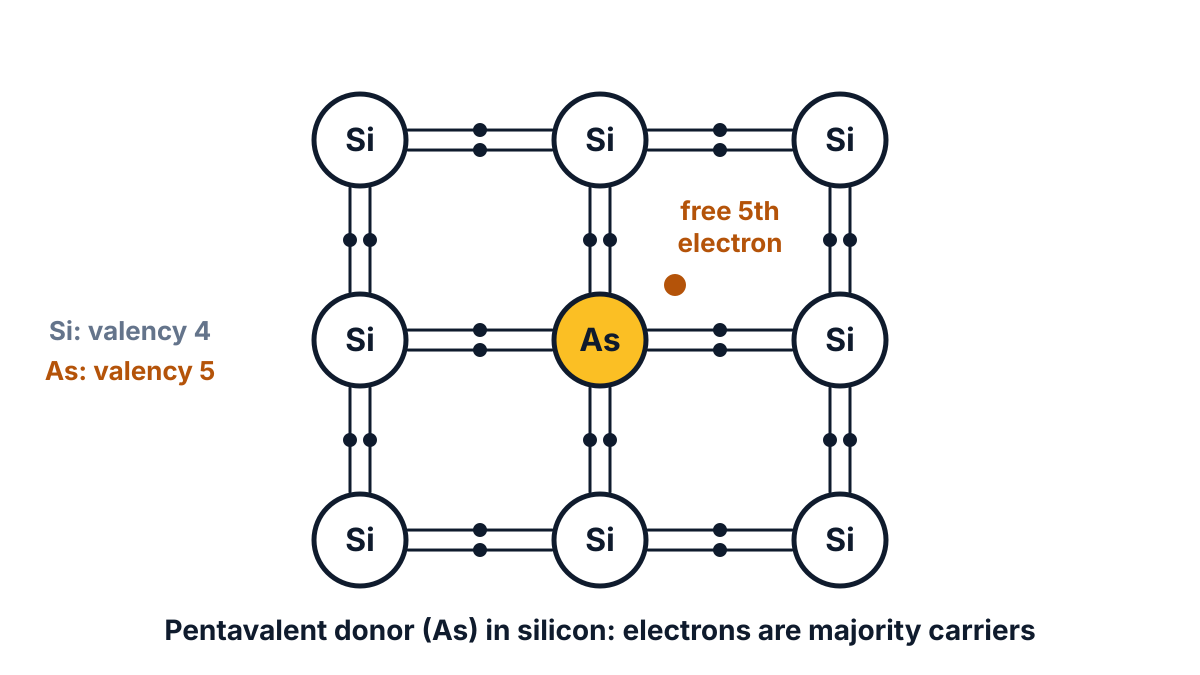
Figure: the arsenic atom has one electron left over after its four bonds, and that electron carries current.
- Four of the five valence electrons of the impurity atom form covalent bonds with the neighbouring Si atoms.
- The fifth electron is loosely bound and becomes a free electron. So the impurity is called a donor.
- In an n-type semiconductor, electrons are the majority carriers and holes are the minority carriers. The crystal as a whole stays electrically neutral.
Q10. Write any three applications of optical fibers. (3 marks)
An optical fibre carries light along a thin glass core by total internal reflection. Its main applications are:
- Telecommunication: telephone lines, internet and cable TV signals travel as light pulses over long distances with little loss.
- Medicine: endoscopes use fibre bundles to see inside the stomach, lungs and other organs without surgery.
- Computer networks (LAN) and defence communication, because fibres are fast and hard to tap.
- Sensors for pressure, temperature and strain, and decorative lighting.
Key points to write: communication, endoscopy, computer networks.
Q11. (a) State and explain triangle law of addition of vectors. (b) A force of 50 N acts at 60° to the horizontal. Find its horizontal and vertical components. (10 marks)
This question has two parts: (a) carries 6 marks and (b) carries 4 marks.
(a) Triangle law of vectors (6 marks)
Statement: if two vectors are represented in magnitude and direction by the two sides of a triangle taken in the same order, then their resultant is represented in magnitude and direction by the third side of the triangle taken in the reverse order.
Explanation:
- Let A and B be the two vectors, with angle θ between them.
- Draw OP to represent vector A in magnitude and direction.
- From the head P of vector A, draw PQ to represent vector B. Now A and B are taken in order (head to tail).
- Join O to Q. The closing side OQ, taken from O to Q (reverse order), represents the resultant R.
- So R = A + B, or OQ = OP + PQ.
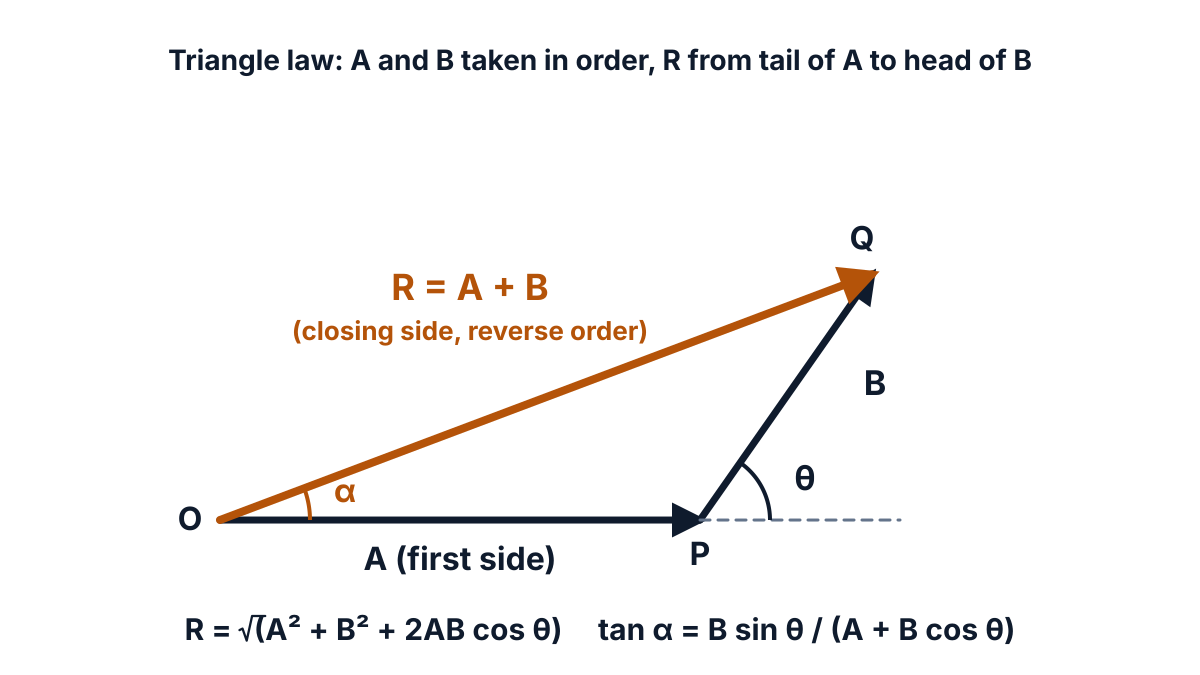
Figure: the resultant starts at the tail of A and ends at the head of B.
The magnitude and direction of the resultant are:
- R = √(A² + B² + 2AB cos θ)
- tan α = B sin θ / (A + B cos θ), where α is the angle R makes with A
This head-to-tail method is the triangle law of vector addition. Two special cases help you check: when θ = 0°, R = A + B (maximum), and when θ = 180°, R = A − B (minimum).
(b) Resolution of a force (4 marks)
Given: F = 50 N, θ = 60° with the horizontal.
- Horizontal component: Fx = F cos θ = 50 × cos 60° = 50 × 0.5 = 25 N
- Vertical component: Fy = F sin θ = 50 × sin 60° = 50 × 0.866 = 43.3 N
- Check: √(25² + 43.3²) = 50 N, which equals the given force.
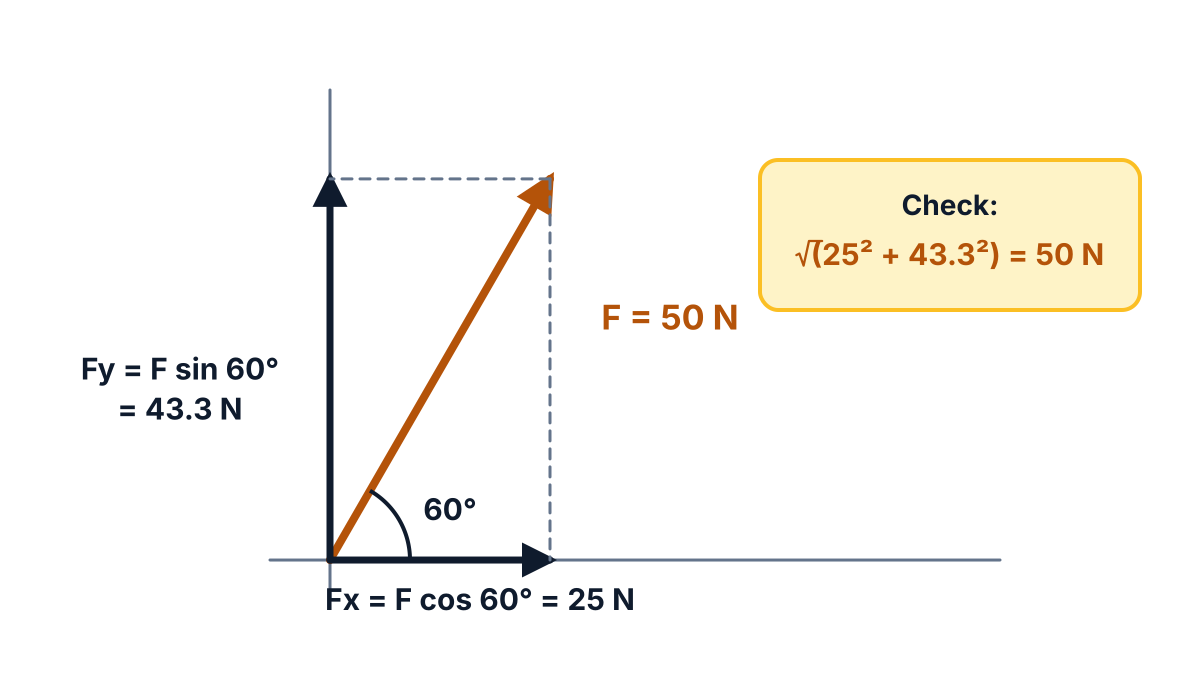
Figure: the two components are the sides of a rectangle whose diagonal is the 50 N force.
Answer: Fx = 25 N (horizontal), Fy = 43.3 N (vertical).
Exam tip: The angle is measured from the horizontal, so cos goes with the horizontal part. If the angle were given from the vertical, sin and cos would swap.
Q12. (a) State and explain the Newton’s law of gravitation. (b) Find the gravitational force between balls of 1 kg and 5 kg placed 10 cm apart. (10 marks)
Part (a) carries 6 marks and part (b) carries 4 marks.
(a) Newton’s law of gravitation (6 marks)
Statement: every particle of matter in the universe attracts every other particle with a force that is directly proportional to the product of their masses and inversely proportional to the square of the distance between them. The force acts along the line joining the two particles.
Explanation:
- Let two bodies of masses m₁ and m₂ be at a distance r apart.
- F ∝ m₁ m₂ (product of masses)
- F ∝ 1 / r² (inverse square of distance)
- Combining, F ∝ m₁ m₂ / r², so F = G m₁ m₂ / r²
- G is the universal gravitational constant. Its value is G = 6.67 × 10⁻¹¹ N m² kg⁻².
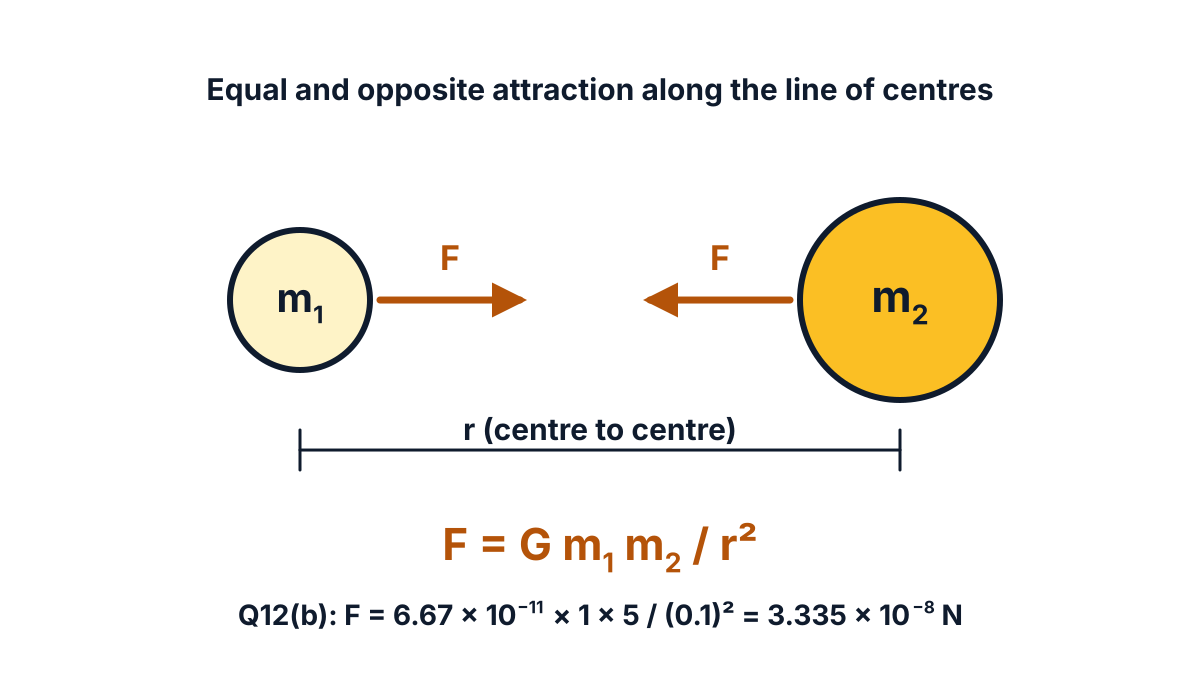
Figure: the two forces are equal in size and opposite in direction, as an action-reaction pair.
Definition of G: if m₁ = m₂ = 1 kg and r = 1 m, then F = G. So G is the force of attraction between two unit masses placed unit distance apart.
Features of the law:
- The force is always attractive.
- The forces on the two bodies are equal and opposite.
- It does not depend on the medium between the bodies.
- G is the same everywhere in the universe, so it is called a universal constant.
(b) Gravitational force sum (4 marks)
Given: m₁ = 1 kg, m₂ = 5 kg, r = 10 cm = 0.1 m, G = 6.67 × 10⁻¹¹ N m² kg⁻².
- Formula: F = G m₁ m₂ / r²
- r² = (0.1)² = 0.01 m²
- G m₁ m₂ = 6.67 × 10⁻¹¹ × 1 × 5 = 3.335 × 10⁻¹⁰ N m²
- F = 3.335 × 10⁻¹⁰ / 0.01 = 3.335 × 10⁻⁸ N
Answer: F = 3.335 × 10⁻⁸ N (about 3.34 × 10⁻⁸ N), a very small force.
Exam tip: Convert 10 cm to 0.1 m before you square it. Using r = 10 gives an answer 10⁴ times too small.
Q13. (a) Derive the relationship between g and G. (b) Write the various applications of artificial satellites. (10 marks)
Each part carries 5 marks.
(a) Relation between g and G (5 marks)
Here g is the acceleration due to gravity and G is the universal gravitational constant. Consider a body of mass m on the surface of the earth.
- Let M be the mass of the earth and R its radius. The earth acts as if all its mass is at its centre, so the distance between the body and the centre of the earth is R.
- By Newton’s law of gravitation, the force on the body is F = G M m / R².
- This force is the weight of the body, so F = m g.
- Equating the two: m g = G M m / R²
- Cancelling m: g = G M / R², or G M = g R².
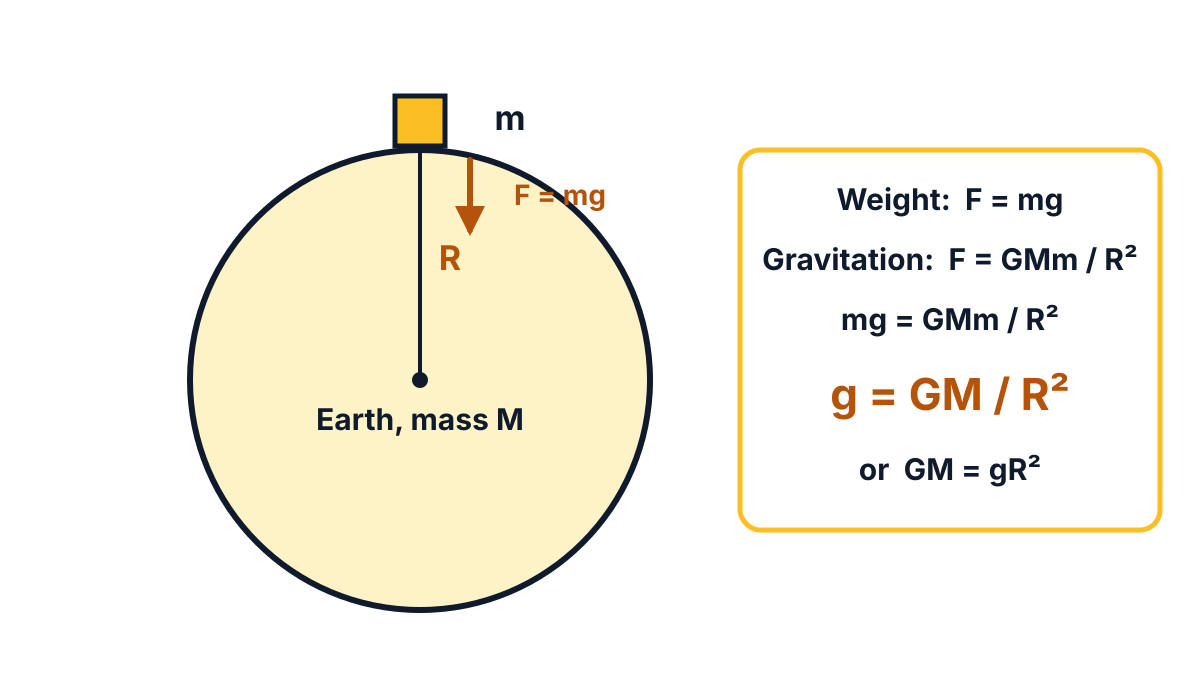
Figure: the weight of the body and the gravitational pull of the earth are the same force.
Points from the result:
- g does not depend on the mass m of the body, so all bodies fall with the same acceleration (without air resistance).
- g depends on R, so g is less at higher altitudes and at the equator.
- Check with the earth’s values, M = 6.0 × 10²⁴ kg and R = 6.4 × 10⁶ m: g = 6.67 × 10⁻¹¹ × 6.0 × 10²⁴ / (6.4 × 10⁶)² = 9.77 m s⁻², which is close to 9.8 m s⁻².
(b) Applications of artificial satellites (5 marks)
An artificial satellite is a man-made object placed in orbit around the earth. Its uses are:
- Communication: geostationary satellites relay telephone calls, television and internet signals across the country and the world.
- Weather forecasting: they photograph clouds and track cyclones, so warnings can be given early.
- Remote sensing: they survey crops, forests, water bodies, minerals and floods.
- Navigation: satellite positioning systems (like GPS) give the exact location of ships, aircraft, vehicles and mobile phones.
- Scientific research: they study the upper atmosphere, the sun, stars and outer space.
- Defence and mapping: they help in border surveillance and in making accurate maps.
- Education: satellite TV channels carry distance education to remote villages.
Key points to write: communication, weather, remote sensing, navigation, research, defence.
Q14. (a) State the law of conservation of energy with an example. (b) Explain the principle and working of photovoltaic cell. (10 marks)
Part (a) carries 3 marks and part (b) carries 7 marks.
(a) Law of conservation of energy (3 marks)
Statement: energy can neither be created nor destroyed; it can only be changed from one form to another. The total energy of an isolated system always stays constant.
Example (freely falling body): a body of mass m is held at height h.
- At the top: PE = mgh, KE = 0, total = mgh.
- As it falls, PE decreases and KE increases by the same amount.
- Just before it hits the ground: PE = 0, KE = mgh, total = mgh.
The total mechanical energy is mgh at every point. Other examples: a dynamo changes mechanical energy into electrical energy, and an electric bulb changes electrical energy into light and heat.
(b) Photovoltaic cell (7 marks)
Principle (photovoltaic effect): when light falls on a p-n junction, an emf is produced across the junction. A photovoltaic cell (solar cell) uses this effect to change light energy directly into electrical energy.
Construction:
- A solar cell is made from a silicon wafer. The main body is p-type silicon.
- A very thin n-type layer is formed on top, so that light can reach the junction.
- A metal grid (finger) contact is placed on the top surface so most of the surface stays open to light. A full metal back contact covers the bottom.
- An anti-reflection coating on top reduces the light lost by reflection.
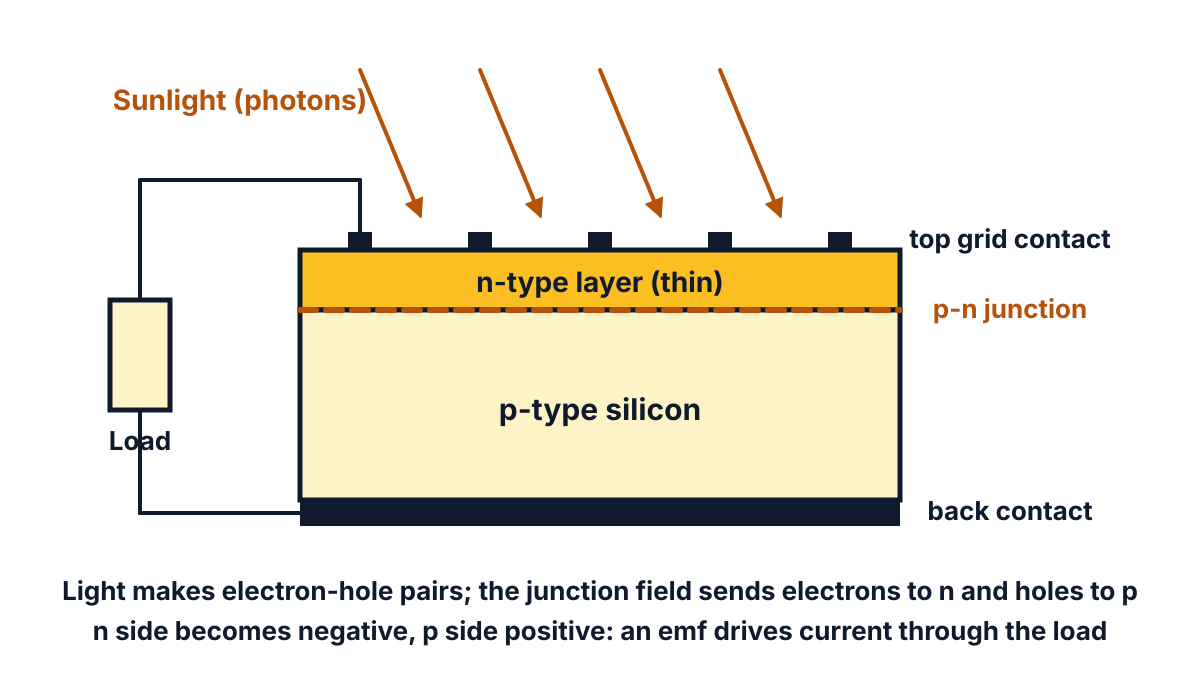
Figure: light enters through the gaps in the top grid and reaches the p-n junction just below the surface.
Working:
- Photons of sunlight with enough energy enter the cell and are absorbed near the junction.
- Each absorbed photon breaks a covalent bond and creates an electron-hole pair.
- The electric field at the junction pushes the electrons into the n-region and the holes into the p-region.
- Electrons collect in the n-side, making it negative. Holes collect in the p-side, making it positive.
- This separation of charge gives a potential difference (emf) across the cell.
- When a load is connected between the top and back contacts, current flows through it as long as light falls on the cell.
Uses: solar panels on rooftops, street lights, calculators, water pumps and satellites. Many cells are joined in series and parallel to make a panel with more voltage and current.
Key points to write: photovoltaic effect, p-n junction, electron-hole pairs, junction field separates charges, emf.
Q15. (a) Derive the ideal gas equation. (b) What are the different modes of transmission of heat? (10 marks)
Part (a) carries 7 marks and part (b) carries 3 marks.
(a) Ideal gas equation (7 marks)
The ideal gas equation combines Boyle’s law and Charles’ law.
- Boyle’s law: at constant temperature, PV = constant, or V ∝ 1/P.
- Charles’ law: at constant pressure, V/T = constant, or V ∝ T.
Derivation: let a gas change from state 1 (P₁, V₁, T₁) to state 2 (P₂, V₂, T₂). Do this in two steps.
- Step 1 (constant temperature T₁): change the pressure from P₁ to P₂. Let the volume become V. By Boyle’s law, P₁V₁ = P₂V, so V = P₁V₁ / P₂ … (1)
- Step 2 (constant pressure P₂): change the temperature from T₁ to T₂. The volume changes from V to V₂. By Charles’ law, V / T₁ = V₂ / T₂, so V = V₂T₁ / T₂ … (2)
- Equating (1) and (2): P₁V₁ / P₂ = V₂T₁ / T₂
- Rearranging: P₁V₁ / T₁ = P₂V₂ / T₂
- So for a fixed mass of gas, PV / T = constant.
- For one mole of gas, this constant is the same for all gases. It is called the universal gas constant R. So PV = RT for one mole.
- For n moles, PV = nRT. This is the ideal gas equation.
Value of R (for one gram mole): at STP, one mole of any gas occupies 22.4 litres. Take P = 1.013 × 10⁵ Pa, V = 22.4 × 10⁻³ m³ = 0.0224 m³ and T = 273 K.
- PV = 1.013 × 10⁵ × 0.0224 = 2269.12 J
- R = PV / T = 2269.12 / 273 = 8.31 J mol⁻¹ K⁻¹
The accepted value is R = 8.314 J mol⁻¹ K⁻¹. R is the same for all gases because one mole of every gas occupies the same volume at the same temperature and pressure (Avogadro’s law).
Exam tip: T must always be in kelvin in PV = nRT. Using °C gives wrong answers, because the gas laws work only on the absolute scale.
(b) Modes of transmission of heat (3 marks)
Heat flows from a hot body to a cold body in three ways:
- Conduction: heat passes from particle to particle without the particles moving from their places. It happens mainly in solids. Examples: the handle of a metal spoon in hot tea gets hot; heating of a soldering iron tip.
- Convection: heat is carried by the actual movement of the heated particles. It happens in liquids and gases. Examples: boiling of water, land and sea breezes.
- Radiation: heat travels as electromagnetic waves and needs no medium. Examples: heat from the sun reaching the earth; warmth felt near a fire.
Q16. (a) Write any five methods of reducing noise pollution. (b) Define echo. Write three applications of it. (10 marks)
Each part carries 5 marks.
(a) Methods of reducing noise pollution (5 marks)
Noise pollution is unwanted, loud sound that harms health and comfort. It can be reduced by these methods:
- Silencers and maintenance: fit silencers on vehicles and generators. Oil and service machines regularly so they run quietly.
- Control of horns and loudspeakers: ban pressure horns, and limit loudspeakers near hospitals, schools and at night.
- Sound-absorbing materials: use acoustic tiles, curtains, carpets and double-glazed windows in halls and homes.
- Green belts: plant trees along roads and around factories. Trees absorb and scatter sound.
- Location of industries: keep factories, airports and railway yards away from houses.
- Machine mounting and enclosures: place heavy machines on rubber or spring pads and inside sound-proof covers.
- Personal protection: workers in noisy places should wear ear plugs or ear muffs.
(b) Echo and its applications (5 marks)
Definition: an echo is the sound heard again after it is reflected from a distant, hard surface such as a wall, a building or a hill. It is the repetition of a sound by reflection.
An echo is an example of reflection of sound. You hear it separately only when the reflected sound reaches you after the original sound has died away in your ear, so the reflecting surface must be far enough. If the echo returns after time t and v is the speed of sound, the distance to the surface is d = v t / 2. We divide by 2 because the sound goes to the surface and comes back.
Applications of echo:
- SONAR: ships send ultrasonic pulses and time the echo to find the depth of the sea and to locate submarines, shoals of fish and sunken ships.
- Medical ultrasound scanning: echoes from organs form images of the heart, liver and a baby in the womb.
- Finding the speed of sound: knowing the distance to a wall and timing the echo gives v = 2d / t.
- Navigation by bats and dolphins: they send high-frequency sounds and use the echoes to find obstacles and prey.
- Locating minerals and oil: echoes of sound waves from rock layers under the ground show where oil and minerals are.
Q17. (a) Derive an expression for balancing condition of Wheatstone bridge with neat circuit diagram. (b) P = 3 Ω, Q = 4 Ω, S = 8 Ω; find the fourth resistance to balance the bridge. (10 marks)
Part (a) carries 7 marks and part (b) carries 3 marks.
(a) Balancing condition of Wheatstone bridge (7 marks)
Circuit: four resistances P, Q, R and S are connected to form a closed quadrilateral ABCD.
- P is in arm AB, Q in arm BC, R in arm AD and S in arm DC.
- A battery E with a key K is connected between A and C (battery arm).
- A galvanometer G is connected between B and D (galvanometer arm).
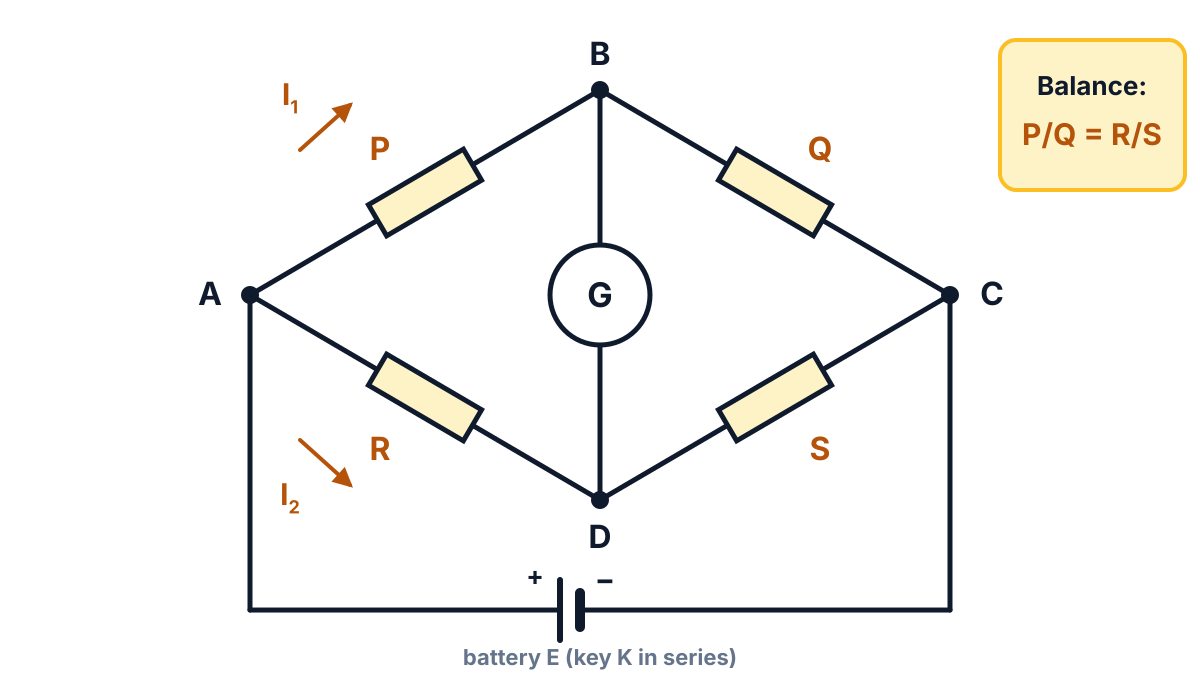
Figure: current I₁ flows through P and Q, current I₂ flows through R and S when the bridge is balanced.
Derivation:
- Close the key. The main current divides at A. Let I₁ flow through P and I₂ through R.
- Adjust the resistances until the galvanometer shows no deflection (Ig = 0). Now the bridge is balanced.
- Since no current flows through G, points B and D are at the same potential.
- Also, the current I₁ in P goes on through Q, and the current I₂ in R goes on through S.
- Potential drop from A to B = potential drop from A to D: I₁ P = I₂ R … (1)
- Potential drop from B to C = potential drop from D to C: I₁ Q = I₂ S … (2)
- Dividing (1) by (2): I₁ P / I₁ Q = I₂ R / I₂ S
- So P / Q = R / S. This is the balancing condition of the Wheatstone bridge.
The same result comes from Kirchhoff’s junction and loop rules with Ig = 0. If three resistances are known, the fourth (unknown) one is found as R = P S / Q. The meter bridge works on this same principle.
(b) Wheatstone bridge sum (3 marks)
Given: P = 3 Ω, Q = 4 Ω, S = 8 Ω. Find R.
- Balance condition: P / Q = R / S
- R = P × S / Q = 3 × 8 / 4 = 24 / 4 = 6 Ω
- Check: P / Q = 3 / 4 = 0.75 and R / S = 6 / 8 = 0.75. Both ratios are equal, so the bridge is balanced.
Answer: the fourth resistance R = 6 Ω.
Q18. (a) Define photoelectric effect. Write any four applications of it. (b) Write any three applications of superconductors. (10 marks)
Part (a) carries 7 marks and part (b) carries 3 marks.
(a) Photoelectric effect (7 marks)
Definition: when light of suitable frequency falls on a metal surface, electrons are emitted from the surface. This is called the photoelectric effect. The emitted electrons are called photoelectrons, and the current they make is called the photoelectric current.
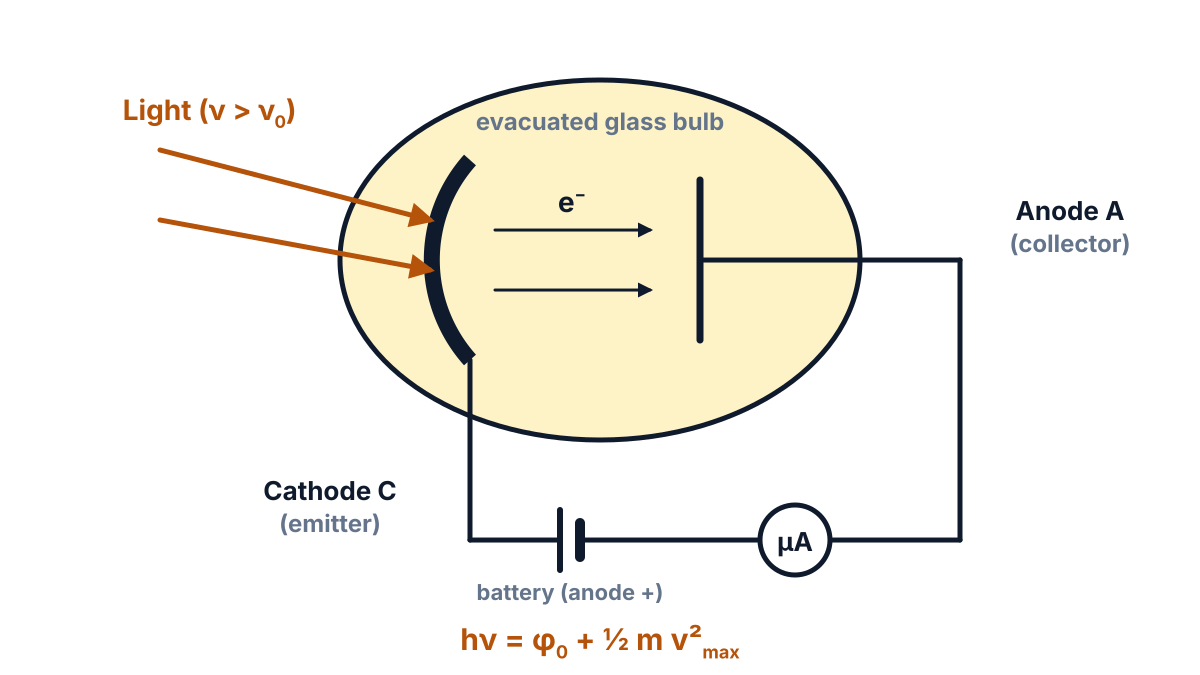
Figure: a photoelectric cell turns light falling on the cathode into a current in the outer circuit.
Einstein’s photoelectric equation: hν = φ₀ + ½ m v²max
- h = Planck’s constant, ν = frequency of the incident light
- φ₀ = work function of the metal (minimum energy needed to free an electron)
- ½ m v²max = maximum kinetic energy of the emitted electron
Laws of photoelectric effect (short points, they support the definition):
- For each metal there is a minimum frequency, the threshold frequency ν₀. Below it, no electrons come out, however bright the light.
- The number of photoelectrons (the current) is proportional to the intensity of light.
- The maximum kinetic energy of the electrons depends on the frequency, not on the intensity.
- Emission is instantaneous; there is no time delay.
These laws follow from Einstein’s photoelectric equation.
Applications of photoelectric effect (photocells):
- Burglar and fire alarms: when someone cuts the light beam falling on a photocell, the current stops and the alarm rings.
- Automatic doors: a person crossing the light beam makes the door open.
- Automatic street lights: a photocell switches the lights on at dusk and off at dawn.
- Sound reproduction in cinema: the sound track on film is changed back into sound using a photocell.
- Counting objects on a conveyor belt in factories.
- Light meters in cameras measure the brightness of light.
(b) Applications of superconductors (3 marks)
A superconductor is a material whose electrical resistance becomes zero below a certain temperature called the critical temperature. Its applications are:
- Powerful electromagnets for MRI scanners in hospitals and for particle accelerators.
- Maglev trains that float above the track by magnetic levitation and run with very little friction.
- Power cables and transformers with almost no energy loss, because the resistance is zero.
- SQUIDs, very sensitive detectors of tiny magnetic fields, and fast switching elements in computers.
Key points to write: MRI magnets, maglev trains, lossless power transmission.
FAQ
Which units carry the most marks in the EE-103 March 2026 paper?
Gravitation, Concepts of energy and Electricity and Magnetism each carry a full 10-mark Part B question plus Part A questions. Gravitation alone has two Part B questions (Q12 and Q13), so it is worth 20 marks of choice.
Which five Part B questions are easiest to score in this paper?
Q17 (Wheatstone bridge), Q12 (Newton’s law of gravitation with a short sum), Q11 (triangle law and resolution of a force), Q15 (ideal gas equation) and Q13 (g and G, satellites). They are standard derivations with short sums that give full marks when the steps and units are right.
What is the answer to the Wheatstone bridge sum in Q17(b)?
With P = 3 Ω, Q = 4 Ω and S = 8 Ω, the balance condition P/Q = R/S gives R = P × S / Q = 3 × 8 / 4 = 6 Ω.
Is Q4 asking about 100 °C or −100 °C?
The printed paper says −100 °C. Some text copies drop the minus sign. −100 °C is 173 K (173.15 K with the exact relation).
Sources
- AP SBTET C-23 DEEE EE-103 question paper, March/April 2026
- C-23 Curriculum, Diploma in Electrical and Electronics Engineering, SBTET AP
- Prescribed textbook: Intermediate Physics Vol. 1 & 2, Telugu Academy (English version)
- Reference books (C-23 syllabus):
- S.L. Gupta & Sanjeev Gupta: Unified Physics Vol. 1-4
- H.C. Verma: Concepts of Physics Vol. 1 & 2
- Resnick & Halliday: Textbook of Physics Vol. 1 & 2
- Brijlal & Subramanyam: Fundamentals of Physics
- Dhanpat Roy: Textbook of Applied Physics
- NCERT Physics textbooks, Class XI & XII
- NCERT Class XI Physics, Motion in a Plane
- NCERT Class XI Physics, Gravitation
- NCERT Class XI Physics, Thermal Properties of Matter
- NCERT Class XI Physics, Kinetic Theory
- NCERT Class XI Physics, Waves
- NCERT Class XII Physics, Current Electricity
- NCERT Class XII Physics, Magnetism and Matter
- NCERT Class XII Physics, Ray Optics and Optical Instruments
- NCERT Class XII Physics, Dual Nature of Radiation and Matter
- NCERT Class XII Physics, Semiconductor Electronics
Writes and reviews the SBTET EEE Papers solutions: AP SBTET diploma question papers answered step by step from the prescribed syllabus.