EE-104 Engineering Chemistry Mar-Apr 2026 paper solved: molarity sum, galvanic cell, ion exchange
 Nookesh Karri ·· 24 min read

This post solves the AP SBTET C-23 engineering chemistry question paper March 2026 (EE-104, Engineering Chemistry and Environmental Studies, March/April 2026 board exam, common first-year paper). It answers all 10 Part A questions and all 8 Part B questions, with balanced equations, the molarity sum worked step by step, and six diagrams. You can open the original question paper PDF to check the questions.
Engineering Chemistry question paper March 2026: pattern and syllabus units
The March 2026 EE-104 paper follows the usual C-23 pattern: 3 hours, 80 marks. Part A has 10 compulsory questions of 3 marks each (30 marks). Part B has 8 questions of 10 marks each, and you answer any 5 (50 marks). Questions 13, 15, 17 and 18 are split into parts (a) and (b). The units below follow the C-23 DEEE curriculum.
| Q no | Topic | Syllabus unit | Marks |
|---|---|---|---|
| 1 | Aufbau principle | Unit 1: Fundamentals of Chemistry | 3 |
| 2 | Orbital, shapes of s and p | Unit 1: Fundamentals of Chemistry | 3 |
| 3 | Mole, moles in NaOH | Unit 2: Solutions, Acids and Bases | 3 |
| 4 | Ionic product of water, pH | Unit 2: Solutions, Acids and Bases | 3 |
| 5 | Electrolyte, non-electrolyte | Unit 3: Electrochemistry | 3 |
| 6 | Anodic coating | Unit 4: Corrosion | 3 |
| 7 | Soft and hard water | Unit 5: Water Treatment | 3 |
| 8 | Addition polymerisation | Unit 6: Polymers and Engineering Materials | 3 |
| 9 | Hydrogen as a fuel | Unit 7: Fuels | 3 |
| 10 | E-waste and its sources | Unit 8: Environmental Studies | 3 |
| 11 | Covalent bond in O₂ and N₂ | Unit 1: Fundamentals of Chemistry | 10 |
| 12 | Molarity and normality sum | Unit 2: Solutions, Acids and Bases | 10 |
| 13 | Bohr model; buffer solutions | Units 1 and 2 | 5 + 5 |
| 14 | Galvanic cell | Unit 3: Electrochemistry | 10 |
| 15 | Composition cell; corrosion factors | Unit 4: Corrosion | 5 + 5 |
| 16 | Ion-exchange softening | Unit 5: Water Treatment | 10 |
| 17 | PVC, Teflon; Nichrome, Duralumin | Unit 6: Polymers and Engineering Materials | 6 + 4 |
| 18 | Water pollution control; acid rain | Unit 8: Environmental Studies | 6 + 4 |
Pick Q12, Q14, Q16 and Q17 first in Part B. Each is a fixed textbook answer built on a sum, a diagram or equations, so the marks are safe. Take Q11 or Q18 as the fifth. More papers for this subject are listed on the engineering chemistry subject page.
Q1. State and explain Aufbau’s principle. (3 marks)
Statement: In the ground state of an atom, electrons enter the orbitals in the order of increasing energy. The lowest-energy orbital is filled first, then the next one. The German word “aufbau” means “building up”, as the chapter on the structure of the atom explains.
Explanation: The energy of an orbital is decided by the (n + l) rule. The orbital with the lower (n + l) value has lower energy and fills first. If two orbitals have the same (n + l), the one with the lower n fills first. So the order is 1s, 2s, 2p, 3s, 3p, 4s, 3d, 4p, 5s. Here 4s (n + l = 4) fills before 3d (n + l = 5).
Example: sodium (Z = 11) is 1s² 2s² 2p⁶ 3s¹.
Key points to write: statement, (n + l) rule, filling order, one configuration.
Q2. Define Orbital. Draw the shapes of s and p-orbitals. (3 marks)
Orbital: An orbital is the region of space around the nucleus where the probability of finding an electron is maximum. One orbital holds at most two electrons with opposite spins.
- s orbital: spherical in shape and the same in all directions (non-directional).
- p orbitals: dumbbell shaped, with two lobes on opposite sides of the nucleus. There are three p orbitals, pₓ, p_y and p_z, along the x, y and z axes.
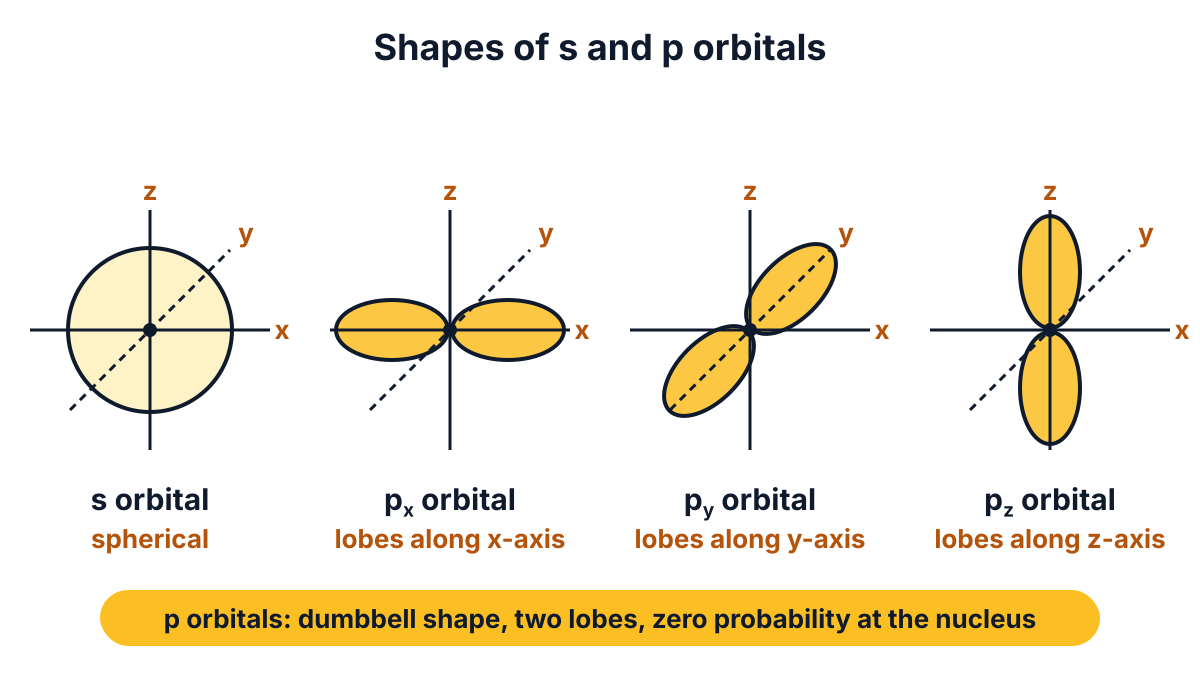
Figure: the s orbital is one sphere; each p orbital has two lobes and a node at the nucleus.
Key points to write: definition, sphere for s, dumbbell for p, three orientations.
Q3. Define mole. Find the number of moles present in 120 gm of NaOH. (3 marks)
Mole: One mole is the amount of a substance that contains 6.022 × 10²³ particles (atoms, molecules or ions). This number is the Avogadro constant. One mole of a compound weighs its gram molecular weight.
Given: weight of NaOH, w = 120 g.
- Molecular weight of NaOH = Na + O + H = 23 + 16 + 1 = 40 g/mol.
- Number of moles = weight / molecular weight = 120 / 40.
- Number of moles = 3 mol.
Answer: 120 g of NaOH contains 3 moles.
Q4. Define (i) Ionic product of water and (ii) pH. (3 marks)
(i) Ionic product of water (Kw): It is the product of the molar concentrations of H⁺ and OH⁻ ions in water at a given temperature.
Kw = [H⁺][OH⁻] = 1 × 10⁻¹⁴ mol²/L² at 25 °C (298 K). The value of Kw changes with temperature, as the chapter on equilibrium notes.
(ii) pH: pH is the negative logarithm (to base 10) of the hydrogen ion concentration of a solution.
pH = −log[H⁺]
Example: pure water has [H⁺] = 10⁻⁷ M, so pH = 7 (neutral). Acids have pH below 7 and bases above 7.
Key points to write: both definitions, Kw value with temperature, pH formula.
Q5. Define electrolyte and non-electrolyte. Give an example. (3 marks)
Electrolyte: A substance that conducts electricity in the molten state or in aqueous solution, and is decomposed by the current. It conducts because it splits into free ions. Examples: NaCl, HCl, CuSO₄.
Non-electrolyte: A substance that does not conduct electricity in the molten state or in aqueous solution, because it does not form ions. Examples: sugar, urea, glucose.
Key points to write: two definitions, “free ions” as the reason, one example each.
Q6. Explain Anodic coating of metals. Give an example. (3 marks)
Anodic coating: The base metal is coated with a metal that is more anodic (more active, higher in the electrochemical series) than itself.
- If the coating gets a scratch or a crack, the coating metal becomes the anode and corrodes first. The base metal is the cathode and stays protected. So the coating protects the base metal by sacrificing itself.
- Example: galvanising, which is a coating of zinc on iron by dipping iron in molten zinc. Zinc is more anodic than iron, so zinc corrodes and iron does not rust even at a scratch.
Key points to write: coating metal more anodic, it corrodes in place of the base metal, zinc on iron.
Q7. Define soft water and hard water with its examples. (3 marks)
Soft water: Water that gives lather easily with soap. Examples: rain water, distilled water.
Hard water: Water that does not give lather easily with soap, because it contains dissolved salts of calcium and magnesium, such as Ca(HCO₃)₂, Mg(HCO₃)₂, CaCl₂ and MgSO₄. These salts react with soap and form a sticky white scum instead of lather:
2C₁₇H₃₅COONa + CaCl₂ → (C₁₇H₃₅COO)₂Ca ↓ + 2NaCl
Examples: well water, bore-well water, sea water.
Key points to write: soap action for both, the Ca and Mg salts, examples.
Q8. Define addition polymerisation. Give an example. (3 marks)
Addition polymerisation: It is the joining of many small unsaturated molecules (monomers with a double bond) to form a big molecule (polymer) without losing any small molecule like water. The polymer has the same empirical formula as the monomer.
Example: ethylene forms polyethylene (polythene) when heated under high pressure with a catalyst.
n CH₂=CH₂ → (–CH₂–CH₂–)ₙ
Key points to write: monomers with double bond, no by-product, ethylene to polythene equation.
Q9. Write any three advantages of hydrogen gas as a fuel. (3 marks)
- Clean fuel: hydrogen burns to give only water (2H₂ + O₂ → 2H₂O). In a fuel cell it produces only water, so there is no CO₂, smoke or ash.
- High calorific value: hydrogen gives more heat per gram than any other common fuel.
- Large raw material: it can be made from water by electrolysis, and water is plentiful.
A fourth point you may add: hydrogen can run fuel cells that give electricity directly.
Q10. What is e-waste? State the sources of e-waste. (3 marks)
E-waste: E-waste (electronic waste) is discarded electrical and electronic equipment that is broken, outdated or no longer wanted. The WHO e-waste fact sheet warns that it harms health and the environment when it is not recycled properly.
Sources of e-waste:
- Homes: old TVs, mobile phones, computers, refrigerators, washing machines.
- Offices and IT companies: computers, printers, servers, UPS batteries.
- Industries: rejected electronic parts and circuit boards.
- Hospitals and labs: old medical and testing equipment.
Q11. Define covalent bond. Explain the formation of a covalent bond in O₂ and N₂ molecules using Lewis dot method. (10 marks)
Covalent bond: A covalent bond is the bond formed by the mutual sharing of one or more pairs of electrons between two atoms, so that each atom gets a stable octet (8 electrons in the outer shell). The shared pair belongs to both atoms. Example: H₂ shares one pair (H–H).
Lewis dot method: The valence electrons of each atom are shown as dots around its symbol. Shared pairs are drawn between the two symbols. One shared pair is a single bond, two pairs a double bond, three pairs a triple bond, as in the chapter on chemical bonding.
(a) Formation of O₂ molecule
- Oxygen (Z = 8) has configuration 2, 6. It has 6 valence electrons and needs 2 more for an octet.
- Each oxygen atom gives 2 electrons for sharing. So two pairs of electrons are shared between the two atoms.
- After sharing, each O atom has 4 lone electrons (2 lone pairs) + 4 shared electrons = 8 electrons.
- Two shared pairs form a double bond: O=O.
(b) Formation of N₂ molecule
- Nitrogen (Z = 7) has configuration 2, 5. It has 5 valence electrons and needs 3 more.
- Each nitrogen atom gives 3 electrons for sharing. So three pairs are shared.
- After sharing, each N atom has 2 lone electrons (1 lone pair) + 6 shared electrons = 8 electrons.
- Three shared pairs form a triple bond: N≡N. This strong triple bond is why N₂ is very unreactive.
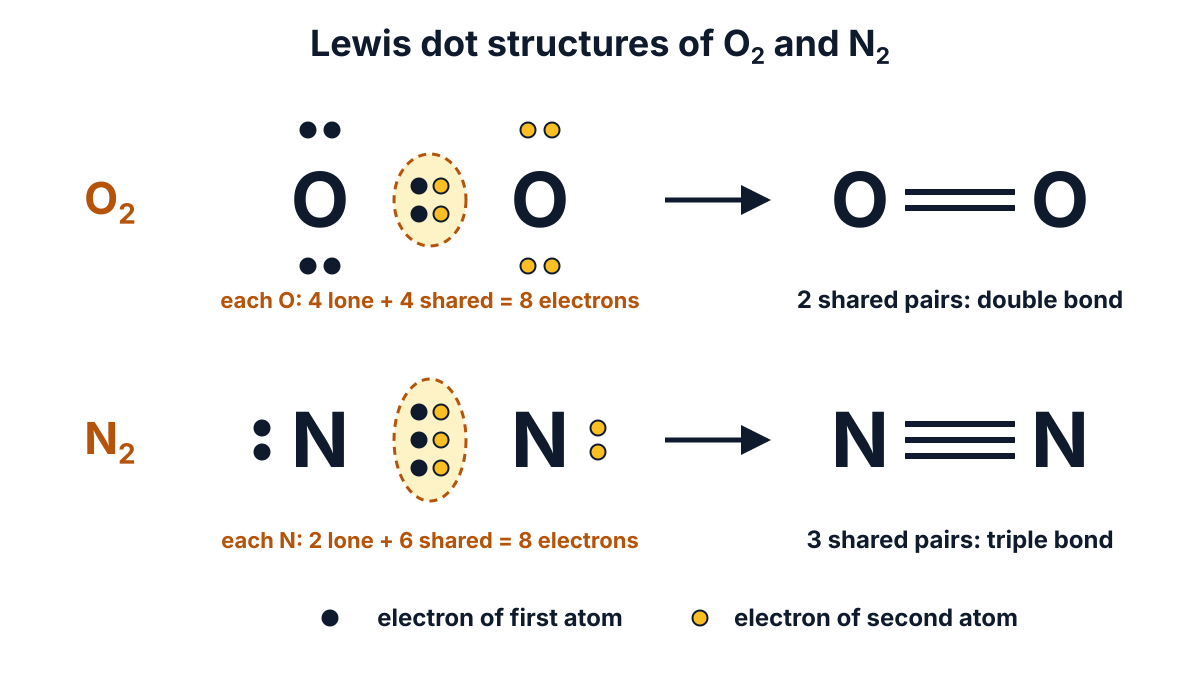
Figure: count the dots around each atom; both O and both N atoms reach 8 electrons.
Key points to write: definition, valence electrons of O and N, number of shared pairs, octet for each atom, O=O and N≡N, the Lewis diagrams.
Q12. Define molarity and normality. Calculate the molarity and normality of 250 ml of solution that contains 4.9 gm of sulphuric acid (H₂SO₄). (10 marks)
Molarity (M): Molarity is the number of moles of solute dissolved in one litre of solution. Unit: mol/L (written M).
M = (w × 1000) / (GMW × V)
Normality (N): Normality is the number of gram equivalents of solute dissolved in one litre of solution. Unit: g eq/L (written N).
N = (w × 1000) / (GEW × V)
Here w = weight of solute in grams, GMW = gram molecular weight, GEW = gram equivalent weight, V = volume of solution in ml.
Given: w = 4.9 g of H₂SO₄, V = 250 ml.
Step 1: Molecular weight of H₂SO₄
- GMW = 2(H) + S + 4(O) = 2(1) + 32 + 4(16)
- GMW = 2 + 32 + 64 = 98 g
Step 2: Equivalent weight of H₂SO₄
H₂SO₄ has two replaceable H⁺ ions, so its basicity is 2.
- GEW = GMW / basicity = 98 / 2
- GEW = 49 g
Step 3: Molarity
- M = (4.9 × 1000) / (98 × 250)
- M = 4900 / 24500
- M = 0.2 M
Check: moles = 4.9 / 98 = 0.05 mol in 0.25 L, so M = 0.05 / 0.25 = 0.2 M.
Step 4: Normality
- N = (4.9 × 1000) / (49 × 250)
- N = 4900 / 12250
- N = 0.4 N
Check: N = M × basicity = 0.2 × 2 = 0.4 N.
Answer: Molarity = 0.2 M, Normality = 0.4 N.
Exam tip: Convert 250 ml correctly. If you use the formula with 1000, keep V in ml. If you divide moles by volume, use litres (0.25 L). Mixing the two gives an answer 1000 times off.
Q13. (a) Write main postulates of Bohr’s atomic model. (b) Define buffer solution. Write any three applications of buffer solution. (10 marks)
This question has two parts of 5 marks each.
(a) Postulates of Bohr’s atomic model (5 marks)
- Electrons revolve around the nucleus in fixed circular paths called orbits, shells or stationary states.
- Each orbit has a fixed energy, so orbits are also called energy levels. They are numbered n = 1, 2, 3, 4 (K, L, M, N shells) from the nucleus outwards. Energy increases as n increases.
- While an electron moves in its own orbit, it neither gains nor loses energy.
- Only those orbits are allowed in which the angular momentum of the electron is a whole multiple of h/2π: mvr = nh/2π, where n = 1, 2, 3 and h is Planck’s constant.
- An electron absorbs energy when it jumps from a lower orbit to a higher orbit. It emits energy when it falls back. The energy equals the difference between the two levels: ΔE = E₂ − E₁ = hν.
(b) Buffer solution (5 marks)
Definition: A buffer solution is a solution that resists a change in its pH when a small amount of acid or base is added to it, or when it is diluted.
Types, with the examples of the equilibrium chapter:
- Acidic buffer: a weak acid and its salt with a strong base, e.g. CH₃COOH + CH₃COONa.
- Basic buffer: a weak base and its salt with a strong acid, e.g. NH₄OH + NH₄Cl.
Applications (any three):
- In the human body: blood is a natural buffer that keeps its pH nearly constant, which the body needs to live.
- In electroplating: the plating bath is buffered so that the metal deposits evenly.
- In laboratories: buffers of known pH are used to calibrate pH meters and in chemical analysis.
- In industries: fermentation, dyeing, leather tanning and paper making need a steady pH.
Q14. Define Galvanic cell. Explain the construction and working of galvanic cell with a neat diagram. (10 marks)
Galvanic cell: A galvanic cell (voltaic cell) is a device that converts the chemical energy of a spontaneous redox reaction into electrical energy. The standard example is the Daniell cell.
Construction
- Anode half-cell: a zinc rod dipped in zinc sulphate (ZnSO₄) solution in one beaker.
- Cathode half-cell: a copper rod dipped in copper sulphate (CuSO₄) solution in another beaker.
- Salt bridge: an inverted U-tube filled with KCl (or KNO₃) in agar-agar gel. It joins the two solutions.
- External circuit: the zinc and copper rods are joined by a wire through a voltmeter.
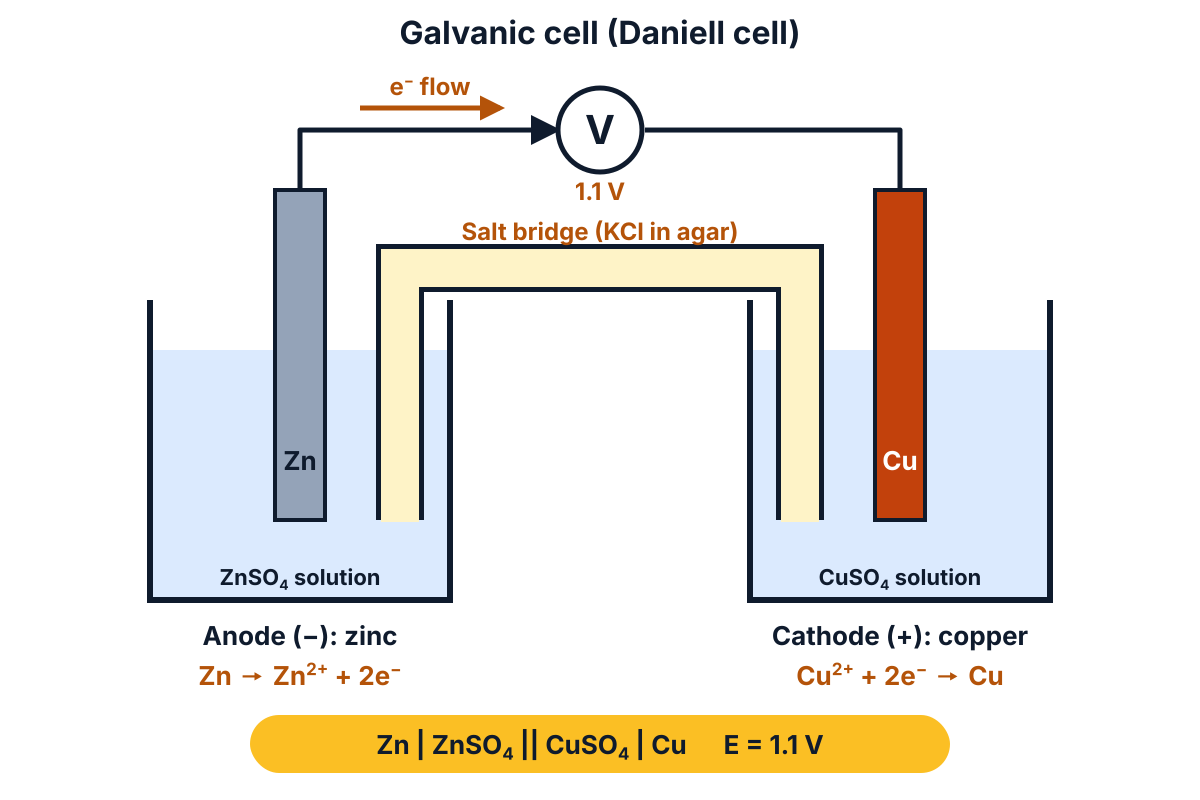
Figure: electrons leave the zinc rod and enter the copper rod through the outer wire.
Working
- At the anode (zinc, negative): zinc atoms lose electrons and go into solution (oxidation). Zn → Zn²⁺ + 2e⁻
- The electrons flow through the outer wire from zinc to copper. The voltmeter shows the cell voltage.
- At the cathode (copper, positive): Cu²⁺ ions from the solution take these electrons and deposit as copper (reduction). Cu²⁺ + 2e⁻ → Cu
- Net cell reaction: Zn + Cu²⁺ → Zn²⁺ + Cu
- Role of the salt bridge: its ions move into the two solutions and keep them electrically neutral. It completes the inner circuit. Without it, the current stops.
- As the cell works, the zinc rod loses weight, the copper rod gains weight, and the blue colour of CuSO₄ slowly fades.
Cell representation and EMF: Zn | ZnSO₄ || CuSO₄ | Cu. The electrochemistry chapter gives E°cell = E°cathode − E°anode = 0.34 V − (−0.76 V) = 1.10 V, which is the 1.1 V shown on the diagram.
Key points to write: definition, the four parts, two half-reactions, net reaction, salt bridge role, cell notation, labelled diagram.
Q15. (a) Explain the composition cell formation with an example. (b) Define corrosion. Explain any three factors that influence the rate of corrosion. (10 marks)
This question has two parts of 5 marks each.
(a) Composition cell (5 marks)
A composition cell (galvanic corrosion cell) forms when two different metals are in contact with each other in the presence of an electrolyte, such as moisture or a water film. The more active metal (higher in the electrochemical series) becomes the anode and corrodes. The less active metal becomes the cathode and is protected.
Example: an iron sheet joined with a copper rivet, exposed to moist air.
- Iron is more active than copper, so iron is the anode: Fe → Fe²⁺ + 2e⁻
- Electrons flow through the metal to copper, the cathode. There, dissolved oxygen and water take them: O₂ + 2H₂O + 4e⁻ → 4OH⁻
- Fe²⁺ and OH⁻ ions combine to give Fe(OH)₂, which oxidises further to rust (Fe₂O₃·xH₂O).
So the iron around the rivet corrodes fast, while the copper rivet stays bright. Other examples: a steel bolt in a copper or brass fitting, and zinc in contact with copper.
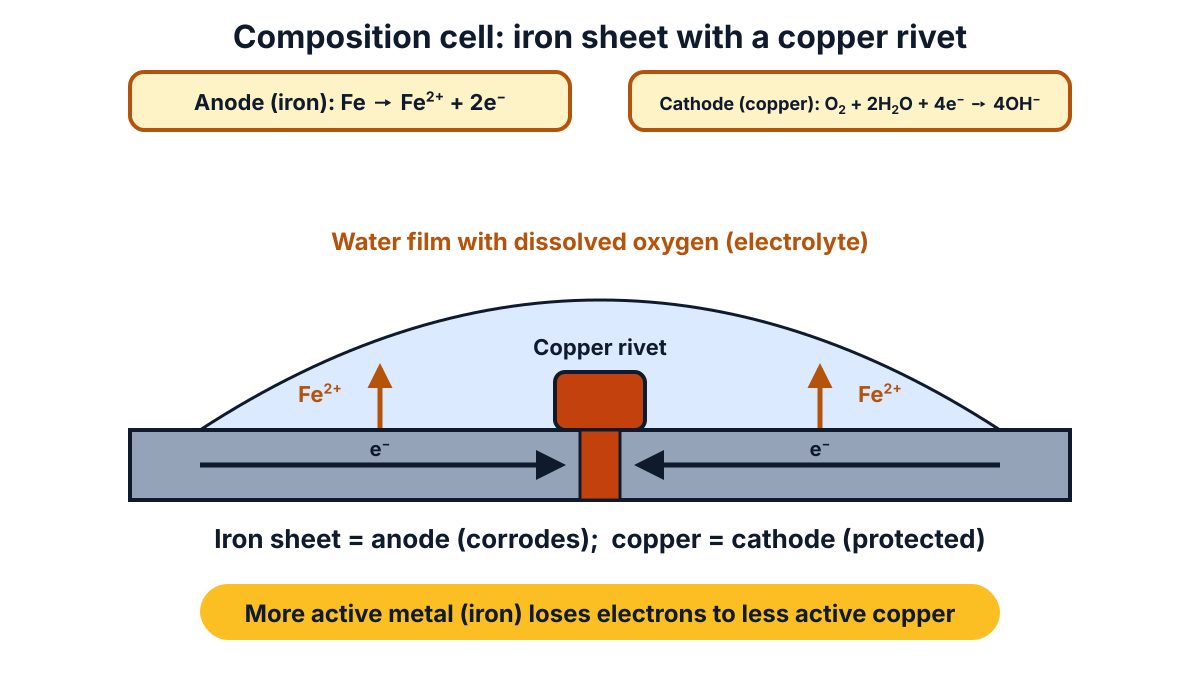
Figure: iron, the more active metal, is the anode and corrodes; copper is the cathode.
(b) Corrosion and the factors that affect its rate (5 marks)
Corrosion: Corrosion is the slow destruction of a metal by chemical or electrochemical reaction with its surroundings. Example: rusting of iron, which forms hydrated ferric oxide, Fe₂O₃·xH₂O, as the electrochemistry chapter shows.
Factors (any three):
- Nature of the metal: a metal higher in the electrochemical series (more active) corrodes faster. Impure metals corrode faster than pure ones, because the impurities form small galvanic cells.
- Relative areas of anode and cathode: a small anode joined to a large cathode corrodes very fast, because a large cathode demands many electrons from a small anode area.
- Moisture and temperature: corrosion needs an electrolyte, so humid air speeds it up. A higher temperature also increases the rate.
- pH of the medium: acidic surroundings (low pH) corrode metals faster than neutral or basic ones.
- Nature of the corrosion product: if the oxide layer is dense and sticks well (like Al₂O₃ on aluminium), it protects the metal and corrosion stops. A porous layer (like rust) lets corrosion go on.
Q16. Define hard water. Explain Ion-exchange process of softening of hard water with a neat diagram. (10 marks)
Hard water: Hard water is water that does not give lather easily with soap, because it contains dissolved bicarbonates, chlorides and sulphates of calcium and magnesium.
- Temporary hardness is due to Ca(HCO₃)₂ and Mg(HCO₃)₂. Boiling removes it.
- Permanent hardness is due to CaCl₂, MgCl₂, CaSO₄ and MgSO₄. Boiling does not remove it.
Ion-exchange process (demineralisation)
Ion-exchange resins are insoluble, cross-linked organic polymers with acidic or basic groups. Two columns are used one after the other.
- Cation exchanger (RH₂): a resin with acidic groups such as –COOH or –SO₃H. It exchanges its H⁺ ions for Ca²⁺ and Mg²⁺ ions. RH₂ + Ca²⁺ → RCa + 2H⁺ RH₂ + Mg²⁺ → RMg + 2H⁺
- Anion exchanger (R’(OH)₂): a resin with basic groups (amino groups). It exchanges its OH⁻ ions for Cl⁻ and SO₄²⁻ ions. R’(OH)₂ + 2Cl⁻ → R’Cl₂ + 2OH⁻ R’(OH)₂ + SO₄²⁻ → R’SO₄ + 2OH⁻
- The H⁺ and OH⁻ ions released combine to form water: H⁺ + OH⁻ → H₂O
- The water coming out of the second column is free of all hardness-causing ions. It is called soft water or demineralised water.
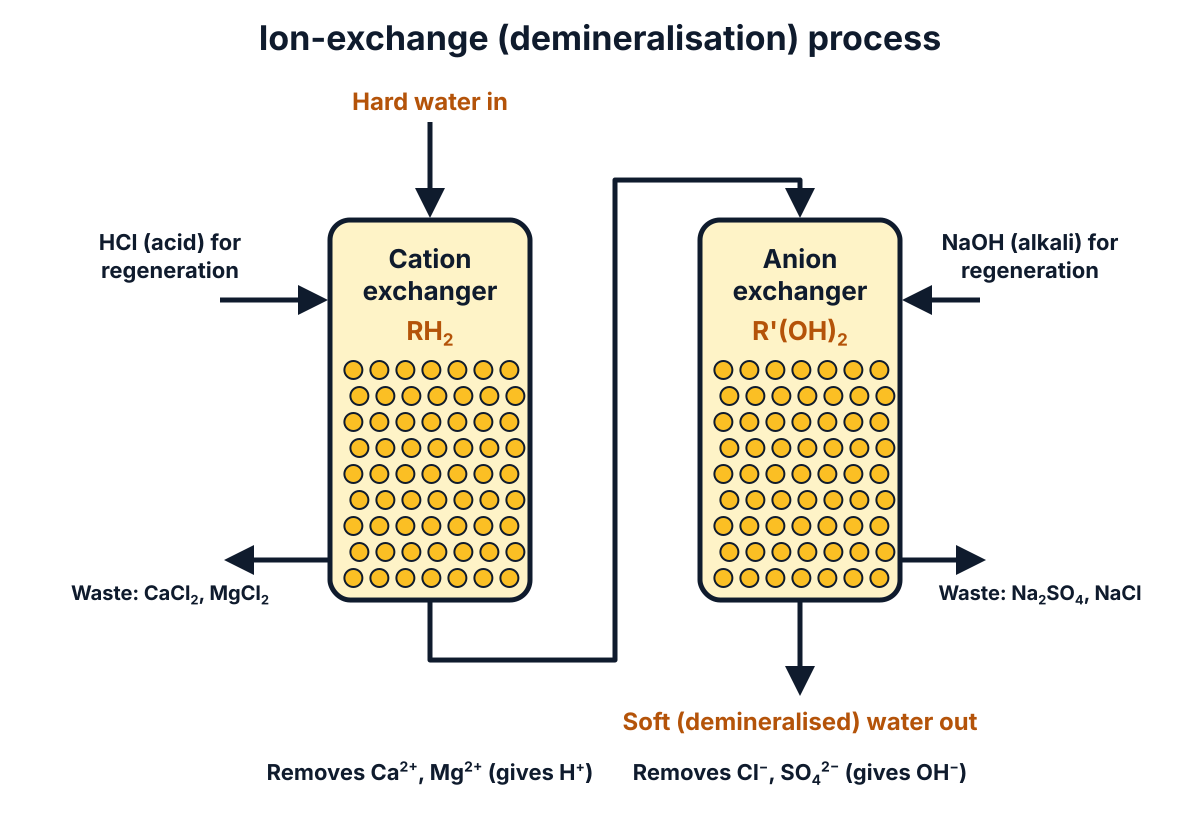
Figure: water passes through the cation column first and the anion column next.
Regeneration
After long use, the resins are exhausted. They are regenerated as follows:
- Cation exchanger with dilute HCl: RCa + 2HCl → RH₂ + CaCl₂
- Anion exchanger with dilute NaOH: R’Cl₂ + 2NaOH → R’(OH)₂ + 2NaCl, and R’SO₄ + 2NaOH → R’(OH)₂ + Na₂SO₄
The washings (CaCl₂, MgCl₂, NaCl, Na₂SO₄) go to waste.
Advantages: it removes both temporary and permanent hardness, gives water of very low hardness that suits boilers, and works for acidic or alkaline water. Limitation: the resins are costly, and turbid water must be filtered first.
Key points to write: definition, types of hardness, two resins with equations, H⁺ + OH⁻ → H₂O, regeneration equations, labelled diagram.
Q17. (a) Define Plastic. Write the preparation and two uses of (i) PVC (ii) Teflon. (b) Write the composition and two applications of (i) Nichrome (ii) Duralumin. (10 marks)
This question has two parts: (a) 6 marks and (b) 4 marks.
(a) Plastics (6 marks)
Plastic: A plastic is a high molecular weight organic polymer that can be moulded into any desired shape by heat and pressure.
(i) PVC (polyvinyl chloride)
Preparation: the monomer vinyl chloride is made from acetylene and HCl.
CH≡CH + HCl → CH₂=CHCl
Vinyl chloride is then heated with a peroxide catalyst (such as benzoyl peroxide). It undergoes addition polymerisation to give PVC.
n CH₂=CHCl → (–CH₂–CHCl–)ₙ
Uses: (1) water pipes and fittings; (2) insulation of electric wires and cables. Also used for raincoats and floor tiles.
(ii) Teflon (polytetrafluoroethylene, PTFE)
Preparation: tetrafluoroethylene is polymerised under pressure in the presence of a peroxide catalyst.
n CF₂=CF₂ → (–CF₂–CF₂–)ₙ
Uses: (1) non-stick coating on cooking pans; (2) insulation for high-temperature wires and cables. Also used for gaskets, valves and seals, since it resists almost all chemicals.
(b) Alloys (4 marks)
| Alloy | Composition | Two applications |
|---|---|---|
| Nichrome | Nickel 80%, chromium 20% | Heating elements of electric irons, heaters, toasters and furnaces; wire-wound resistors |
| Duralumin | Aluminium 95%, copper 4%, magnesium 0.5%, manganese 0.5% | Aircraft frames and parts; automobile parts and bicycle frames |
The nichrome figure is the common 80/20 grade. For duralumin, write the textbook figure above; real alloys vary a little, with copper about 3 to 5% and magnesium and manganese about 0.5 to 1%.
Exam tip: Nichrome has high resistance and does not oxidise when red hot, so it is the heating-element alloy. Duralumin is light and strong, so aircraft use it.
Q18. (a) Explain any three methods used to control water pollution. (b) Write a short note on Acid rain. (10 marks)
This question has two parts: (a) 6 marks and (b) 4 marks.
(a) Methods to control water pollution (6 marks)
Water pollution is any change in the physical, chemical or biological quality of water that makes it harmful to living things. Three control methods:
- Treatment of sewage before discharge: domestic sewage must not go straight into rivers and lakes. It is treated in stages. Primary treatment removes floating and settling solids by screening and sedimentation. Secondary treatment uses microbes (for example, the activated sludge process) to break down organic matter and lower the BOD. Tertiary treatment disinfects the water, for example by chlorination.
- Treatment of industrial effluents: factories must treat their waste water before release. Acidic or alkaline effluents are neutralised. Toxic heavy metals are removed by chemical precipitation. Hot water from power plants is cooled before it is released, to protect fish.
- Control of farm run-off and solid waste: farmers should use fertilisers and pesticides only in needed amounts, and prefer organic manure. Garbage, plastics and e-waste must not be dumped in water bodies.
You may also mention public awareness and strict enforcement of pollution laws by the pollution control boards.
(b) Acid rain (4 marks)
Acid rain is rain, snow or fog that contains sulphuric acid and nitric acid. Normal rain has a pH of about 5.6, due to dissolved CO₂, so rain with a pH below 5.6 is called acid rain (US EPA).
Causes: burning coal and oil in power plants, industries and vehicles releases SO₂ and nitrogen oxides (NOₓ). In the air they react with oxygen and water:
- 2SO₂ + O₂ → 2SO₃, then SO₃ + H₂O → H₂SO₄
- 4NO₂ + O₂ + 2H₂O → 4HNO₃
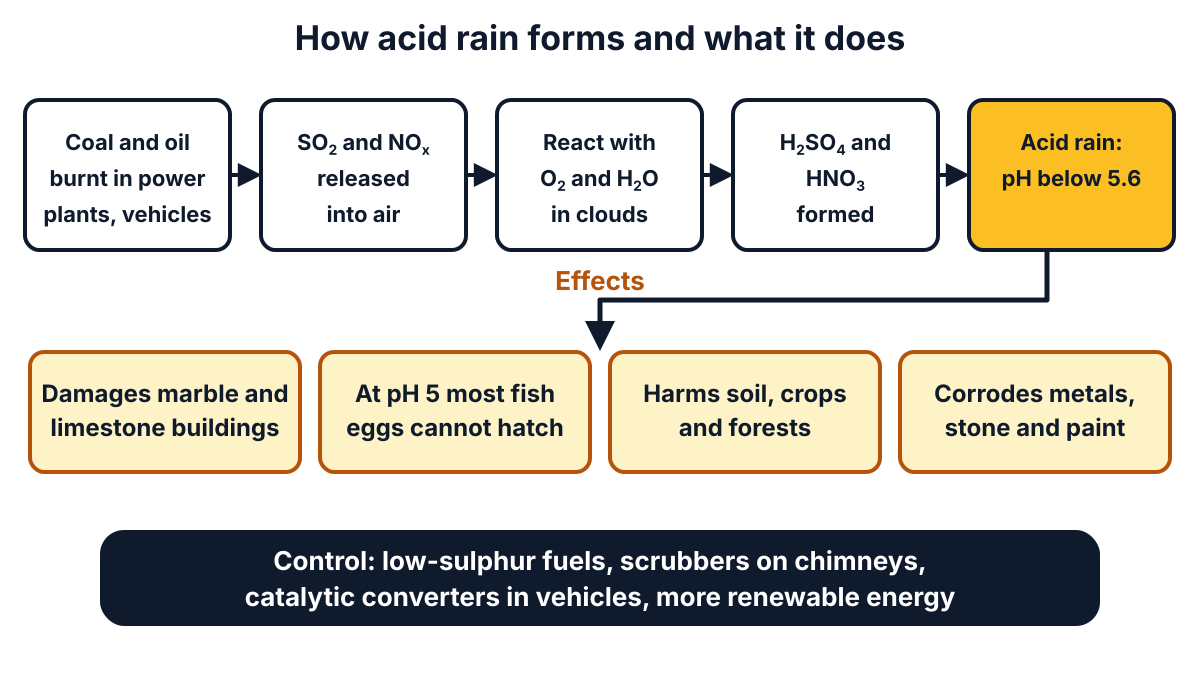
Figure: from fuel burning to acid rain, its effects and its control.
Effects:
- Damages marble and limestone buildings and statues: CaCO₃ + H₂SO₄ → CaSO₄ + H₂O + CO₂
- Makes lakes acidic. At pH 5, most fish eggs cannot hatch.
- Harms soil, crops and forests.
- Corrodes metals and spoils paint.
Control: use low-sulphur fuels, fit scrubbers on chimneys to remove SO₂, use catalytic converters in vehicles, and use more renewable energy.
FAQ
Which Part B questions are easiest to choose in this paper?
Q12 (molarity and normality sum), Q14 (galvanic cell), Q16 (ion-exchange process) and Q17 (plastics and alloys) are direct textbook answers. Add Q11 or Q18 as the fifth. Each one has a standard diagram or a fixed set of equations you can learn in advance.
Which units carry the most marks in the March 2026 EE-104 paper?
Units 1 and 2 (atomic structure, bonding, solutions, acids and bases) carry 42 of the 110 marks printed on the paper: Q1 to Q4 in Part A and Q11, Q12 and Q13 in Part B.
How do I write the molarity and normality sum for full marks?
Write the given data, the molecular weight and equivalent weight of the acid, the formula M = (w × 1000) / (GMW × V in ml), then substitute and give the answer with its unit (M or N). For H₂SO₄, normality is twice the molarity because its basicity is 2.
Are these the official SBTET answers?
No. These are model answers written from the C-23 syllabus and its prescribed books. SBTET does not publish an answer key, and this site is not linked to SBTET AP.
Sources
- AP SBTET C-23 DEEE EE-104 question paper, Mar-Apr 2026
- C-23 Curriculum, Diploma in Electrical and Electronics Engineering, SBTET AP
- Prescribed textbook: Intermediate Chemistry Vol. 1 & 2, Telugu Academy
- Reference books (C-23 syllabus):
- Jain & Jain: Engineering Chemistry
- O.P. Agarwal: Engineering Chemistry, Hi-Tech
- D.K. Sharma: Engineering Chemistry
- A.K. De: Engineering Chemistry
- NCERT Chemistry Class 11, Unit 1: Some Basic Concepts of Chemistry
- NCERT Chemistry Class 11, Unit 2: Structure of Atom
- NCERT Chemistry Class 11, Unit 4: Chemical Bonding and Molecular Structure
- NCERT Chemistry Class 11, Unit 6: Equilibrium
- NCERT Chemistry Class 12, Unit 2: Electrochemistry
- US EPA: What is Acid Rain?
- US EPA: Effects of Acid Rain
- US DOE: Hydrogen Fuel Basics
- WHO fact sheet: Electronic waste (e-waste)
- Nickel-chromium Ni80 Cr20 wire: material information
- Duralumin: composition and uses
Writes and reviews the SBTET EEE Papers solutions: AP SBTET diploma question papers answered step by step from the prescribed syllabus.