EE-103 Engineering Physics Mar-Apr 2025 paper solved: Wheatstone bridge, optical fibre and gas constant R
 Nookesh Karri ·· 25 min read

This post solves the AP SBTET C-23 Engineering Physics question paper of March 2025 (EE-103, the common first year paper, code 23010), question by question. You get all 10 Part A answers and all 8 Part B answers, sized to the marks, with diagrams and every sum worked in SI units. The original question paper PDF is the source of every question below.
Engineering physics question paper March 2025: pattern and syllabus units
The EE-103 paper follows the usual C-23 pattern: Part A has 10 questions of 3 marks (30 marks, answer all), and Part B has 8 questions of 10 marks, of which you answer any 5 (50 marks). The paper is for 3 hours and 80 marks. The units below come from the C-23 DEEE curriculum.
| Q no | Topic | Syllabus unit | Marks |
|---|---|---|---|
| 1 | Rules for writing SI units | Unit 1: Units and measurements | 3 |
| 2 | Scalars and vectors | Unit 2: Statics | 3 |
| 3 | K.E and momentum relation | Unit 4: Concepts of energy | 3 |
| 4 | °F to kelvin conversion | Unit 5: Thermal physics | 3 |
| 5 | Reverberation and reverberation time | Unit 6: Sound | 3 |
| 6 | Velocity of sound from an echo | Unit 6: Sound | 3 |
| 7 | Ohm’s law | Unit 7: Electricity and magnetism | 3 |
| 8 | Magnetic field and lines of force | Unit 7: Electricity and magnetism | 3 |
| 9 | Applications of photoelectric effect | Unit 8: Modern physics | 3 |
| 10 | Total internal reflection | Unit 8: Modern physics | 3 |
| 11 | Triangle law; velocity components | Unit 2: Statics | 10 |
| 12 | Polar satellites; orbital velocity | Unit 3: Gravitation | 10 |
| 13 | Newton’s law of gravitation; uses of satellites | Unit 3: Gravitation | 10 |
| 14 | Work and energy; momentum from K.E | Unit 4: Concepts of energy | 10 |
| 15 | Gas laws; value of R | Unit 5: Thermal physics | 10 |
| 16 | Musical sound and noise; noise control | Unit 6: Sound | 10 |
| 17 | Wheatstone bridge; magnetic inverse square law | Unit 7: Electricity and magnetism | 10 |
| 18 | Optical fibre; intrinsic and extrinsic semiconductors | Unit 8: Modern physics | 10 |
My advice: choose Q14, Q15 and Q17 first, because each has a fixed derivation or definition plus a short sum with one clear answer. Then pick two of Q11, Q12 and Q18, depending on whether you are stronger in vectors, satellites or optics.
Q1. Write any three rules for writing SI units. (3 marks)
Any three of these SI rules are enough:
- Symbols are never plural: 5 kg, not 5 kgs.
- No full stop after a symbol, except at the end of a sentence.
- A unit named after a scientist is written in small letters in full (newton), but its symbol is a capital (N).
- Leave a space between number and symbol: 50 N, not 50N.
Q2. Define scalar and vector quantities with examples. (3 marks)
A scalar quantity has magnitude only and no direction. Examples: mass, length, time, temperature, work and energy.
A vector quantity has both magnitude and direction, and it adds by the triangle law of vectors. Examples: displacement, velocity, acceleration, force and momentum.
For example, “5 kg” is complete as a scalar, but “5 N” of force is incomplete until you say its direction.
Key points to write: scalar = magnitude only; vector = magnitude and direction; two examples each.
Q3. Derive relationship between K.E and momentum. (3 marks)
Take a body of mass m moving with velocity v.
- Kinetic energy: E = ½ m v²
- Momentum: p = m v, so v = p / m
- Put v = p / m in step 1: E = ½ m (p / m)² = ½ m × p² / m²
- So E = p² / 2m, or p = √(2mE)
This kinetic energy result shows that for the same momentum, a lighter body has more kinetic energy.
Answer: E = p² / 2m and p = √(2mE).
Q4. Convert 101 °F into Kelvin. (3 marks)
Given: F = 101 °F.
- First convert to Celsius: C = (F − 32) × 5/9 = (101 − 32) × 5/9 = 69 × 5/9 = 38.33 °C
- Then convert to kelvin: K = C + 273 = 38.33 + 273 = 311.33 K
If you use the exact relation T = tC + 273.15, you get 311.48 K. Both are accepted; write the one your class used.
Answer: 101 °F = 311.33 K (about 311.48 K with 273.15).
Q5. Define reverberation and reverberation time. (3 marks)
Reverberation is the persistence (continuation) of sound in a hall or room after the source has stopped, caused by repeated reflections from the walls, floor and ceiling.
Reverberation time is the time taken for the sound intensity in the hall to fall to one-millionth (10⁻⁶) of its original value after the source stops. Its SI unit is the second (s).
Key points to write: reverberation = persistence of sound by multiple reflections; reverberation time = time for intensity to fall to one-millionth of its first value.
Q6. Calculate the velocity of sound in air, if an observer at a distance of 800 m from a building hears an echo after 5 seconds. (3 marks)
Given: distance to the building d = 800 m, time for the echo t = 5 s.
The sound goes to the building and comes back, so it covers 2d.
- Formula: v = 2d / t
- Substitution: v = (2 × 800) / 5 = 1600 / 5
- Result: v = 320 m/s
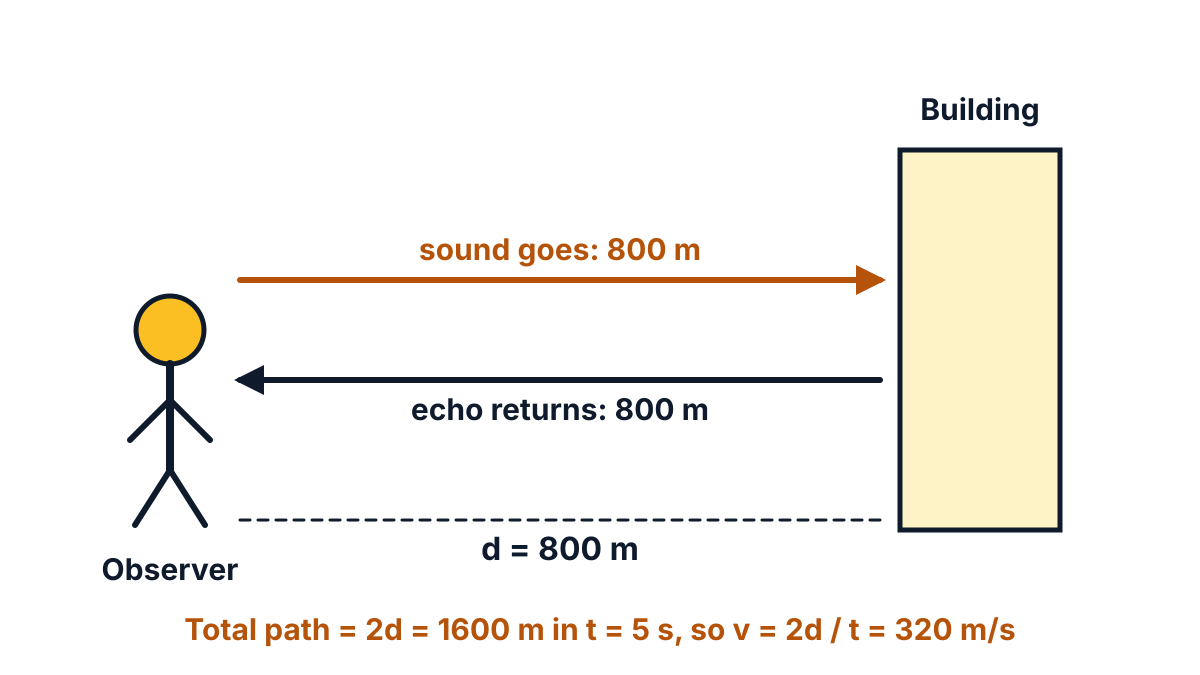
Figure: the echo covers the distance twice, so use 2d, not d.
Exam tip: If you use v = d / t you get 160 m/s, which is wrong. Always double the distance in echo sums.
Answer: Velocity of sound in air = 320 m/s.
Q7. Start and explain Ohm’s law. (3 marks)
“Start” on the paper is a printing error for “State”.
Ohm’s law: At constant temperature, the current (I) through a conductor is directly proportional to the potential difference (V) across its ends.
So V ∝ I, or V = I R, where R is the resistance of the conductor. The SI unit of R is the ohm (Ω).
Explanation: If you double the voltage, the current also doubles, as long as the temperature does not change. The V-I graph is a straight line through the origin, and its slope gives R.
Q8. Define magnetic field magnetic lines of force. (3 marks)
Magnetic field: The region around a magnet (or a current-carrying conductor) in which its magnetic influence can be felt is called the magnetic field.
Magnetic lines of force: A magnetic line of force is the imaginary path along which an isolated north pole would move in a magnetic field. The tangent at any point on the line gives the direction of the magnetic field at that point.
Key points to write: field = region where magnetic force is felt; line of force = path of a free north pole; lines never cross.
Q9. List any three applications of photoelectric effect. (3 marks)
The photoelectric cell turns light into current. Any three uses:
- Burglar and fire alarms: when a light beam on the cell is cut, the current stops and the alarm rings.
- Automatic doors and street lights: the cell switches the door motor or the lamps on and off.
- Sound reproduction in cinema: the sound track on the film is read by a photo cell.
- Light meters in photography, and counting objects on a conveyor in factories.
Key points to write: alarms, automatic doors and street lights, cinema sound, light meters (any three).
Q10. Explain the Total Internal Reflection. (3 marks)
Total internal reflection (TIR): When light goes from a denser medium to a rarer medium (glass to air) at an angle of incidence greater than the critical angle C, all of it is reflected back into the denser medium.
The critical angle is the angle of incidence for which the angle of refraction is 90°, and sin C = 1/n. For crown glass, n = 1.52 and C = 41.14°.
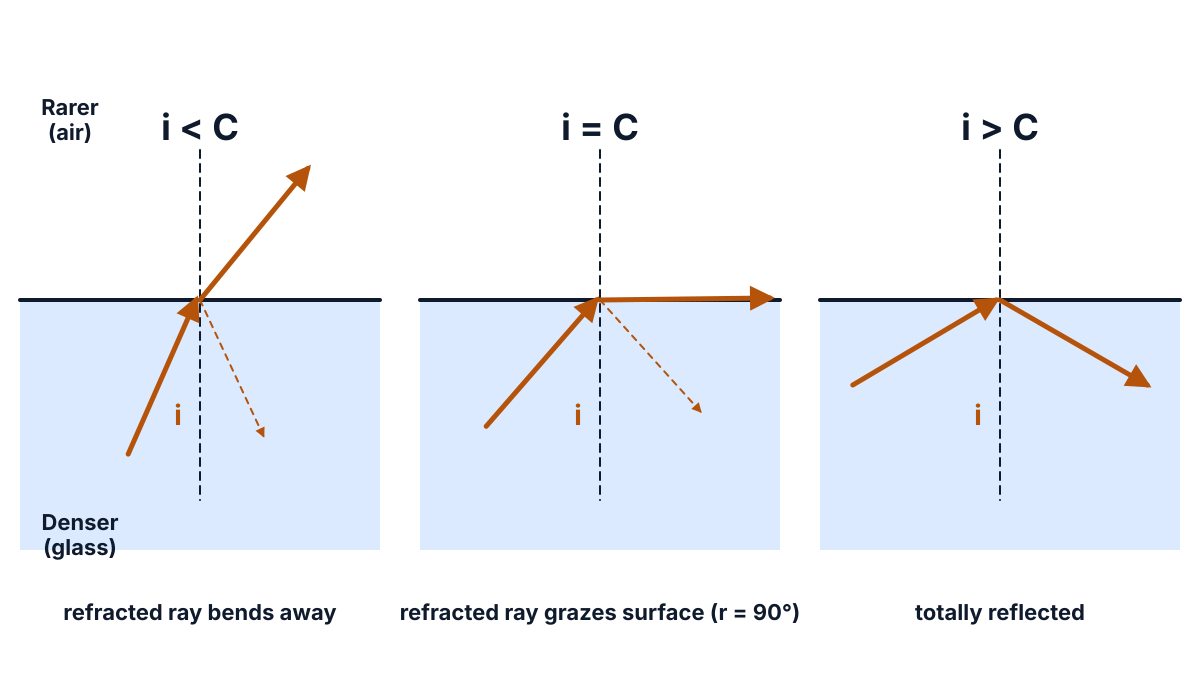
Figure: past the critical angle, refraction stops and all light reflects.
Key points to write: denser to rarer, i > C, sin C = 1/n, used in optical fibres.
Q11. (a) State and explain triangle law of addition of vectors. (b) A body is thrown with some velocity at an angle of 60° with the horizontal. If its horizontal component is 50 m s⁻¹, what is the actual velocity? (10 marks)
Marks split: (a) 2 + 4, (b) 4.
(a) Statement (2 marks). If two vectors are represented in magnitude and direction by the two sides of a triangle taken in the same order, then their resultant is represented in magnitude and direction by the third side of the triangle taken in the opposite order.
Explanation (4 marks). Let vector P be represented by side OA and vector Q by side AB, placed head to tail. The angle between P and Q is θ. Then the closing side OB, from the tail of P to the head of Q, gives the resultant R = P + Q.
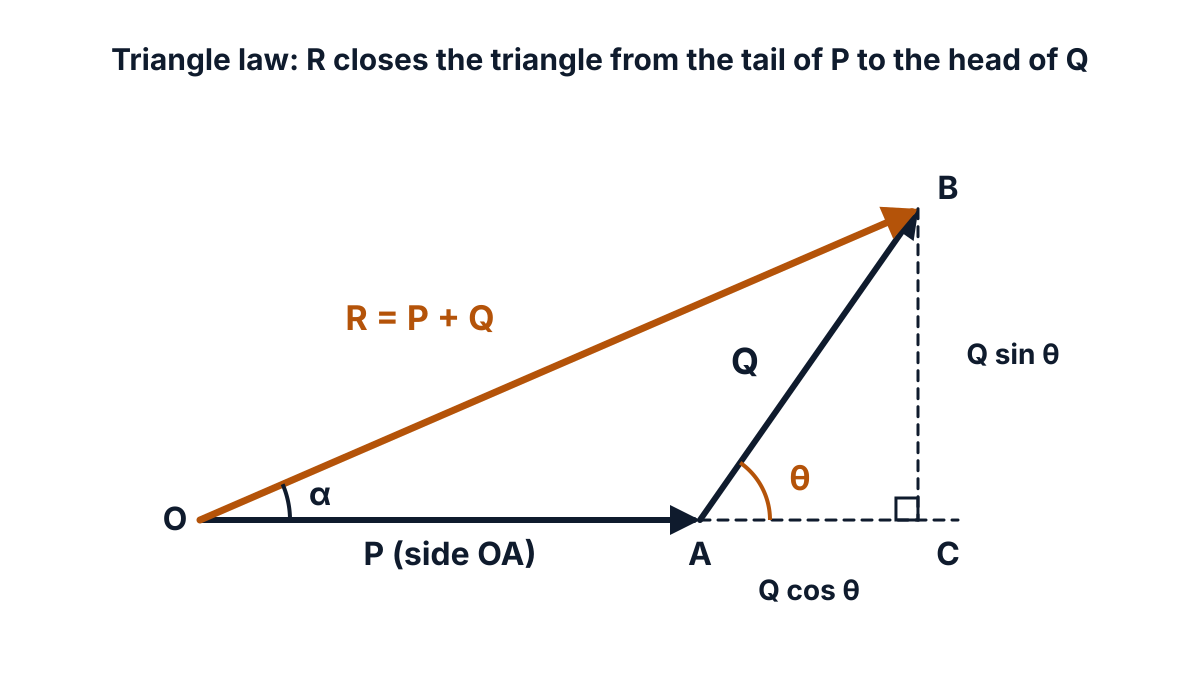
Figure: R closes the triangle; the dashed perpendicular BC gives the magnitude.
To find the magnitude, draw BC perpendicular to OA produced.
- In the right triangle ACB: AC = Q cos θ and BC = Q sin θ.
- In the right triangle OCB: OB² = OC² + BC² = (OA + AC)² + BC².
- So R² = (P + Q cos θ)² + (Q sin θ)² = P² + 2PQ cos θ + Q² (cos² θ + sin² θ).
- Since cos² θ + sin² θ = 1: R = √(P² + Q² + 2PQ cos θ).
- If R makes angle α with P: tan α = BC / OC = Q sin θ / (P + Q cos θ).
Special cases: when θ = 0°, R = P + Q (largest). When θ = 180°, R = P − Q (smallest). When θ = 90°, R = √(P² + Q²).
(b) Solution (4 marks). Given: angle with the horizontal θ = 60°, horizontal component = 50 m/s. Let the actual velocity be v.
- The horizontal component of a velocity is v cos θ.
- So v cos 60° = 50
- cos 60° = 0.5, so v = 50 / 0.5 = 100 m/s
- Check: the vertical component is v sin 60° = 100 × 0.866 = 86.6 m/s.
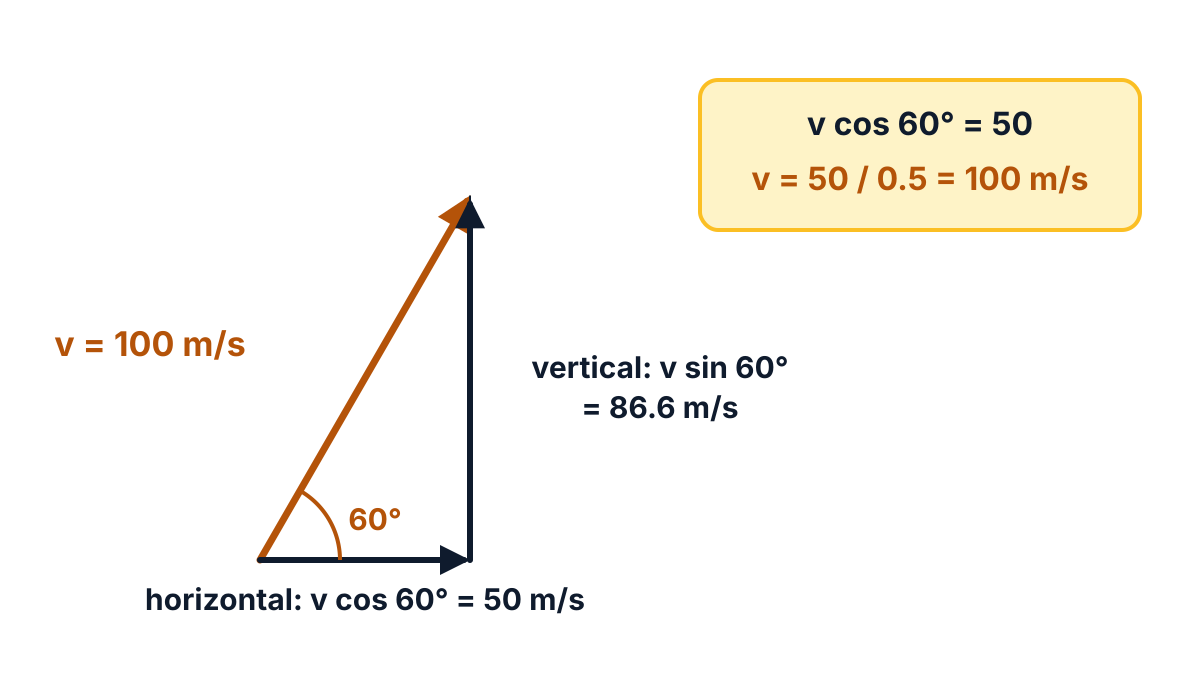
Figure: the horizontal component is the side next to the 60° angle, so it uses cos.
Exam tip: Do not use sin 60° for the horizontal component. That gives 57.7 m/s, which is wrong.
Answer: (a) R = √(P² + Q² + 2PQ cos θ), tan α = Q sin θ / (P + Q cos θ). (b) Actual velocity v = 100 m/s at 60° to the horizontal.
Q12. (a) Write a brief note on Polar Satellites. (b) Define orbital velocity. Calculate the orbital velocity of a body around the earth (g = 9.8 m/s², radius of earth 6.4 × 10⁶ m). (10 marks)
Marks split: (a) 5, (b) 2 + 3.
(a) Polar satellites (5 marks). A polar satellite is an artificial satellite whose orbit passes over (or close to) the North and South Poles of the earth. The main points are:
- Orbit: the satellite moves roughly from one pole to the other, not from west to east. Its orbit plane is nearly perpendicular to the equator.
- Height: polar orbits are low earth orbits, typically between 200 to 1000 km above the earth.
- Coverage: the earth rotates from west to east below the orbit. So on each new round the satellite sees a new strip of the earth, and over time it covers the whole globe.
- Sun-synchronous type: many polar satellites pass over a place at the same local time every day, which makes pictures taken on different days easy to compare.
- Uses: remote sensing of crops, forests and water, weather study, mapping, disaster monitoring and defence.
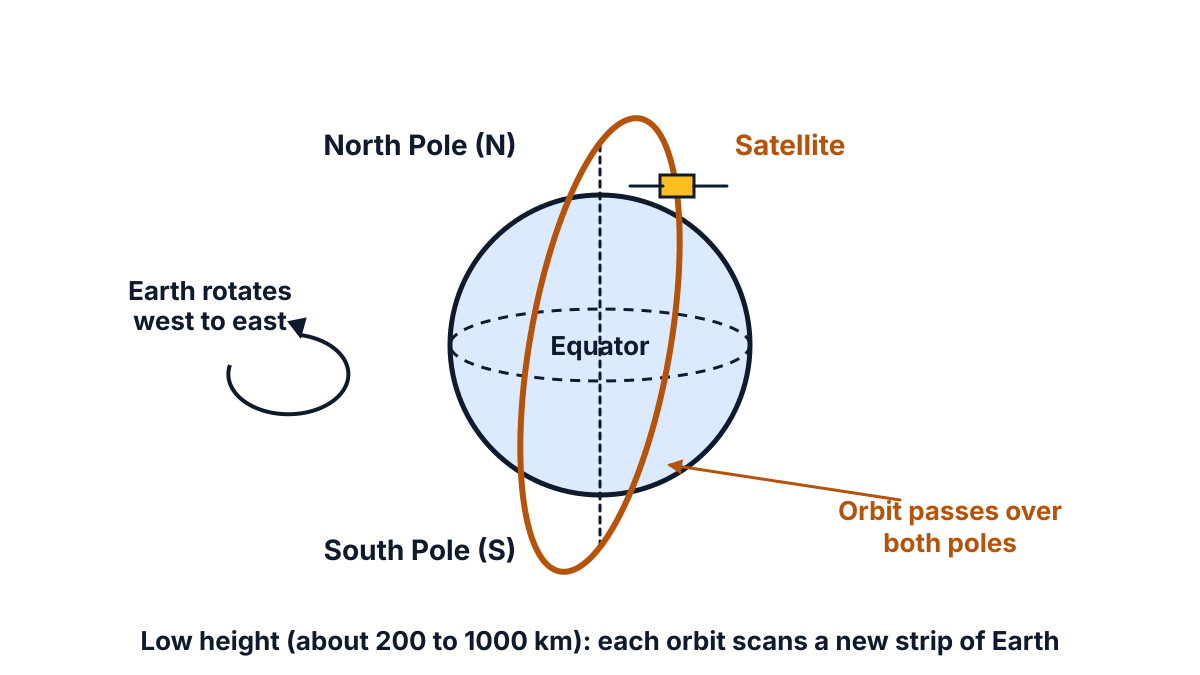
Figure: the orbit stays fixed while the earth turns beneath it, so the whole earth is scanned.
A polar satellite differs from a geostationary satellite, which stays above the equator at a height of 35 786 km and appears fixed over one place.
(b) Orbital velocity: definition (2 marks). Orbital velocity is the velocity that must be given to a satellite so that it revolves in a circular orbit around the earth. For an orbit close to the earth’s surface, v₀ = √(gR).
This comes from equating the centripetal force to the weight: m v₀² / R = m g, so v₀² = gR.
Calculation (3 marks). Given: g = 9.8 m/s², R = 6.4 × 10⁶ m.
- v₀ = √(gR) = √(9.8 × 6.4 × 10⁶)
- v₀ = √(62.72 × 10⁶) = √(6.272 × 10⁷)
- v₀ = 7919.6 m/s ≈ 7.92 km/s
Answer: Orbital velocity near the earth’s surface v₀ ≈ 7.92 × 10³ m/s (about 7.9 km/s).
Q13. (a) State the explain Newton’s universal law of gravitation. (b) Mention any four applications of artificial satellites. (10 marks)
Marks split: (a) 6, (b) 4. “State the explain” is a misprint for “State and explain”.
(a) Statement. Every particle of matter in the universe attracts every other particle with a force that is directly proportional to the product of their masses and inversely proportional to the square of the distance between them.
Explanation. Let two bodies of masses m₁ and m₂ be at a distance r apart.
- F ∝ m₁ m₂
- F ∝ 1 / r²
- Combining: F ∝ m₁ m₂ / r², so F = G m₁ m₂ / r²
Here G is the universal gravitational constant. If m₁ = m₂ = 1 kg and r = 1 m, then F = G. So G is the force of attraction between two unit masses kept unit distance apart. Its value is G = 6.67 × 10⁻¹¹ N m² kg⁻², and it is the same everywhere in the universe.
Features of the gravitational force:
- It is always attractive.
- It acts along the line joining the two bodies.
- The forces on the two bodies are equal and opposite (action and reaction).
- It does not depend on the medium between the bodies.
- It is very weak for small bodies. For two masses of 100 kg each, 1 m apart, F = 6.67 × 10⁻¹¹ × 100 × 100 / 1² = 6.67 × 10⁻⁷ N.
Because of the inverse square law, if the distance is doubled, the force becomes 1/4 of its first value.
(b) Applications of artificial satellites (any four).
- Communication: TV broadcasting, telephone and internet links.
- Weather forecasting: pictures of clouds and cyclones, and early warnings.
- Navigation: GPS for ships, aircraft, vehicles and mobile phones.
- Remote sensing: survey of crops, forests, minerals, water and land use.
- Scientific research and defence: study of space and the earth’s atmosphere, and surveillance.
Key points to write: F = G m₁ m₂ / r², G = 6.67 × 10⁻¹¹ N m² kg⁻², attractive and universal; four uses with one line each.
Q14. (a) Define work done and energy. Mention their SI units. (b) A body of mass 2 kg is moving with kinetic energy of 16 joule. Find its momentem. (10 marks)
Marks split: (a) 4 + 2, (b) 4. “Momentem” on the paper means momentum.
(a) Work done (definition). Work is said to be done when a force acts on a body and the body moves in the direction of the force. Work done = force × displacement in the direction of the force:
W = F s cos θ, where θ is the angle between the force and the displacement.
If θ = 90°, no work is done (for example, a porter carrying a load on a level road does no work against gravity).
Energy (definition). Energy is the capacity (ability) of a body to do work. A body that has more energy can do more work. Its main forms are kinetic energy, potential energy, heat, light, sound, electrical and chemical energy.
SI units. The SI unit of work is the joule (J). One joule is the work done when a force of 1 newton moves a body through 1 metre in its own direction: 1 J = 1 N m. Energy is measured in the same unit, the joule (J), because energy is stored work.
(b) Solution. Given: m = 2 kg, kinetic energy E = 16 J.
- Relation between K.E and momentum: p = √(2mE)
- Substitution: p = √(2 × 2 × 16) = √64
- Result: p = 8 kg m/s
- Check: v = p / m = 8 / 2 = 4 m/s, and ½ × 2 × 4² = 16 J. Correct.
Answer: Momentum p = 8 kg m s⁻¹.
Q15. (a) State Boyle’s law, Charle’s law and Gay-Lussac’s law. (b) Calculate the value of ‘R’ for 1 gram mole of gas. (10 marks)
Marks split: (a) 2 + 2 + 2, (b) 4.
(a) Boyle’s law. At constant temperature, the volume of a given mass of a gas is inversely proportional to its pressure. V ∝ 1/P, so PV = constant, or P₁V₁ = P₂V₂.
Charles’ law. At constant pressure, the volume of a given mass of a gas is directly proportional to its absolute temperature. V ∝ T, so V / T = constant, or V₁/T₁ = V₂/T₂.
Gay-Lussac’s law. At constant volume, the pressure of a given mass of a gas is directly proportional to its absolute temperature. P ∝ T, so P / T = constant, or P₁/T₁ = P₂/T₂.
In all three laws, T is in kelvin, not °C.
(b) Value of R. For n moles of an ideal gas, PV = nRT. For 1 gram mole, PV = RT, so R = PV / T. Take the gas at STP:
- Pressure P = 76 cm of mercury = h ρ g = 0.76 × 13.6 × 10³ × 9.8 = 1.013 × 10⁵ N/m²
- Volume of 1 mole at STP: V = 22.4 litres = 22.4 × 10⁻³ m³
- Temperature T = 0 °C = 273 K
- R = PV / T = (1.013 × 10⁵ × 22.4 × 10⁻³) / 273
- R = 2269.12 / 273 = 8.31 J mol⁻¹ K⁻¹
The accepted value is R = 8.314 J mol⁻¹ K⁻¹. R is the same for all gases because 1 mole of any gas at STP occupies the same 22.4 litres.
Answer: R = 8.31 J mol⁻¹ K⁻¹ for 1 gram mole of gas.
Q16. (a) Distinguish between musical sound and noise. (b) Explain methods of minimizing noise pollution. (10 marks)
Marks split: (a) 4, (b) 6.
(a) Musical sound and noise.
| Musical sound | Noise |
|---|---|
| Produces a pleasant effect on the ear | Produces an unpleasant, irritating effect |
| Produced by regular, periodic vibrations | Produced by irregular, non-periodic vibrations |
| The waveform repeats regularly | The waveform is irregular |
| Has a definite pitch, loudness and quality | Has no definite pitch |
| No sudden change in loudness | Sudden changes in loudness |
| Examples: veena, flute, a trained singer | Examples: traffic horns, machines, crackers |
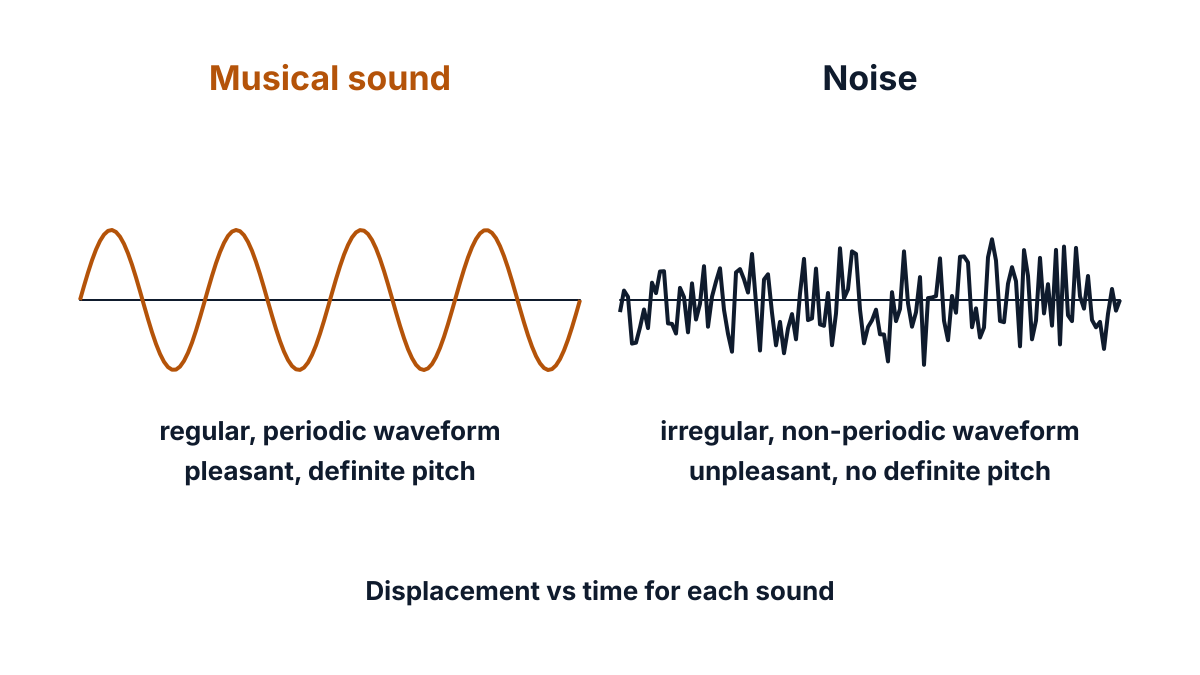
Figure: the regular wave on the left is musical sound; the jagged wave on the right is noise.
(b) Methods of minimizing noise pollution. Noise pollution is unwanted sound that harms health and comfort. You can control it at the source, along the path and at the receiver.
- At the source: fit silencers on vehicles and generators, lubricate and maintain machines, and use quieter machines.
- Rules and laws: ban pressure horns, limit the use of loudspeakers and crackers, and set noise limits for industries.
- Town planning: keep industries, airports and highways away from homes, schools and hospitals.
- Along the path: plant rows of trees, and build sound barrier walls along highways.
- In buildings: use sound-absorbing materials such as curtains, carpets and acoustic tiles, and double-glazed windows.
- At the receiver: workers near loud machines should wear ear plugs or ear muffs.
- Awareness: teach people about the harm caused by loud sound.
Key points to write: table of at least four differences; methods at source, path, receiver, plus laws and town planning.
Q17. (a) Derive an expression for balancing condition of wheatstone’s bridge. (b) If the distance between two magnetic poles is increased to four times, then what happens to the force between them? (10 marks)
Marks split: (a) 7, (b) 3.
(a) Wheatstone’s bridge. Four resistances P, Q, R and S are joined to form a closed quadrilateral ABCD. P is in arm AB, Q in arm BC, R in arm AD and S in arm DC. A cell E (with a key) is connected between A and C. A galvanometer G is connected between B and D.
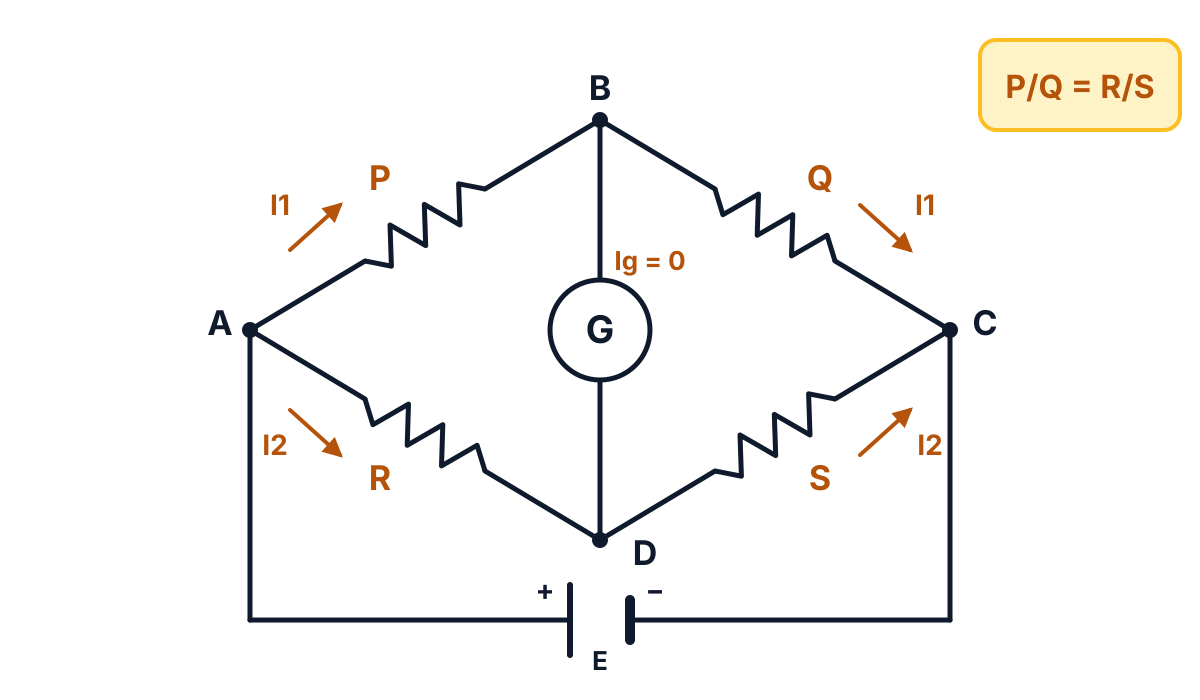
Figure: current I₁ flows through P and Q, current I₂ through R and S; at balance no current flows through G.
Derivation of the balancing condition.
- The current from the cell divides at A: current I₁ flows through P and current I₂ through R.
- The bridge is balanced when the galvanometer shows no deflection, that is Ig = 0. Then B and D are at the same potential.
- Since Ig = 0, by Kirchhoff’s first law the same I₁ flows through Q, and the same I₂ flows through S.
- Apply Kirchhoff’s second law to the closed loop ABDA: −I₁P + I₂R = 0 (Ig = 0, so G gives no drop). So I₁P = I₂R … (1)
- Apply Kirchhoff’s second law to the closed loop BCDB: −I₁Q + I₂S = 0. So I₁Q = I₂S … (2)
- Divide equation (1) by equation (2): I₁P / I₁Q = I₂R / I₂S
- So P / Q = R / S
This is the balancing condition. If P, Q and R are known, the unknown resistance is S = R × Q / P. The meter bridge uses the same balance condition.
(b) Coulomb’s inverse square law of magnetism (3 marks). The force between two magnetic poles of strengths m₁ and m₂, at a distance d apart, is F = (µ₀ / 4π) × m₁ m₂ / d². So F ∝ 1 / d².
- First force: F₁ ∝ 1 / d²
- New distance d₂ = 4d, so F₂ ∝ 1 / (4d)² = 1 / (16 d²)
- F₂ / F₁ = 1 / 16
Answer: (a) P / Q = R / S. (b) The force becomes one-sixteenth (1/16) of its first value.
Q18. (a) Explain the principle and working of optical fiber. (b) Define Intrinsic and extrinsic semiconductors. (10 marks)
Marks split: (a) 6, (b) 4.
(a) Principle. An optical fibre works on the principle of total internal reflection. Light that strikes the boundary of a denser medium with a rarer medium, at an angle of incidence greater than the critical angle, is fully reflected back.
Construction. An optical fibre is a very thin, flexible strand of high-quality glass or plastic. It has three parts:
- Core: the inner part, with a higher refractive index n₁. Light travels in the core.
- Cladding: the layer around the core, with a lower refractive index n₂ (n₁ > n₂).
- Buffer jacket: the outer plastic cover that protects the fibre from damage and moisture.
Working.
- Light enters one end of the core at a small angle to the fibre axis.
- It strikes the core-cladding boundary. Because it is going from a denser (core) to a rarer (cladding) medium and the angle of incidence is greater than the critical angle, it is totally reflected.
- The reflected ray hits the opposite boundary, again at an angle greater than C, and is totally reflected again.
- In this way light travels along the fibre by repeated total internal reflections, even when the fibre is bent gently, and comes out at the far end with very little loss.
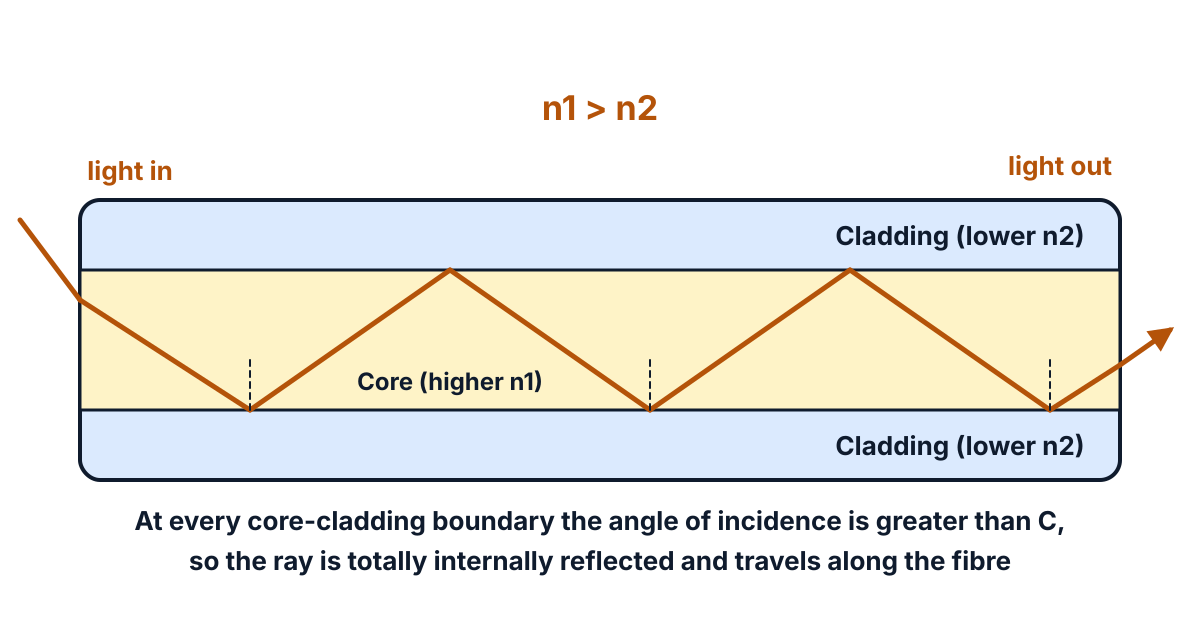
Figure: the ray zig-zags along the core, reflecting totally at every core-cladding boundary.
Uses: telephone and internet communication, endoscopes in medicine, and decorative lamps. The optics chapter covers the index difference.
(b) Intrinsic semiconductor. A semiconductor in its pure form, without any added impurity, is called an intrinsic semiconductor. Examples: pure silicon (Si) and germanium (Ge). In it, the number of free electrons equals the number of holes (nₑ = nₕ).
Extrinsic semiconductor. A semiconductor to which a small amount of a suitable impurity has been added (doped) to increase its conductivity is called an extrinsic semiconductor. It is of two types:
- n-type: doped with a pentavalent impurity such as phosphorus, arsenic or antimony. Electrons are the majority carriers.
- p-type: doped with a trivalent impurity such as boron, aluminium or indium. Holes are the majority carriers.
Key points to write: fibre = TIR, core n₁ > cladding n₂, repeated TIR; intrinsic = pure, nₑ = nₕ; extrinsic = doped, n-type and p-type.
For the other EE-103 sessions, see the Engineering Physics papers list.
FAQ
Which units carry the most marks in the EE-103 March 2025 paper?
Gravitation (Unit 3) carries the most: two full Part B questions (Q12 and Q13). Every other unit from Statics to Modern Physics has one Part B question and one or two Part A questions. Units and Measurements has only Q1.
Which Part B questions are easiest to score in this paper?
Q14 (work, energy and the momentum sum), Q15 (gas laws and R) and Q17 (Wheatstone bridge and the inverse square law) are the safest. Each has a fixed definition part and a short sum with one clear answer.
What is the answer to the echo problem in Q6?
The sound travels to the building and back, so it covers 2 × 800 = 1600 m in 5 s. The velocity of sound is 1600 ÷ 5 = 320 m/s.
Are these answers the official SBTET key?
No. These are model answers written from the C-23 syllabus and its prescribed textbooks. SBTET AP does not publish an official key, and this site is not affiliated with SBTET AP.
Sources
- AP SBTET C-23 DEEE EE-103 question paper, Mar-Apr 2025
- C-23 Curriculum, Diploma in Electrical and Electronics Engineering, SBTET AP
- Prescribed textbook: Intermediate Physics Vol. 1 & 2, Telugu Academy (English version)
- Reference books (C-23 syllabus):
- S.L. Gupta & Sanjeev Gupta: Unified Physics Vol. 1-4
- H.C. Verma: Concepts of Physics Vol. 1 & 2
- Resnick & Halliday: Textbook of Physics Vol. 1 & 2
- Brijlal & Subramanyam: Fundamentals of Physics
- Dhanpat Roy: Textbook of Applied Physics
- NCERT Physics textbooks, Class XI & XII
- NCERT Class XI Physics, Chapter 3: Motion in a Plane
- NCERT Class XI Physics, Chapter 5: Work, Energy and Power
- NCERT Class XI Physics, Chapter 7: Gravitation
- NCERT Class XI Physics, Chapter 10: Thermal Properties of Matter
- NCERT Class XI Physics, Chapter 12: Kinetic Theory
- NCERT Class XII Physics, Chapter 3: Current Electricity
- NCERT Class XII Physics, Chapter 5: Magnetism and Matter
- NCERT Class XII Physics, Chapter 9: Ray Optics and Optical Instruments
- NCERT Class XII Physics, Chapter 11: Dual Nature of Radiation and Matter
- NCERT Class XII Physics, Chapter 14: Semiconductor Electronics
- ESA: Types of orbits
Writes and reviews the SBTET EEE Papers solutions: AP SBTET diploma question papers answered step by step from the prescribed syllabus.