EE-104 Engineering Chemistry Mar-Apr 2025 paper solved: hardness of water, electrolysis of NaCl, cathodic protection
 Nookesh Karri ·· 23 min read

This post solves the AP SBTET C-23 EE-104 Engineering Chemistry and Environmental Studies paper of March/April 2025, the common first year paper for DEEE and other branches. It answers all 10 Part A questions and all 8 Part B questions of the engineering chemistry question paper (March 2025), with each answer sized to its marks, every sum recomputed and diagrams for the cell and corrosion questions. You can open the original question paper PDF next to this page.
Engineering chemistry question paper March 2025: pattern and syllabus units
The EE-104 paper of March 2025 follows the usual C-23 pattern: 3 hours, 80 marks. Part A has 10 questions of 3 marks each (30 marks), all compulsory. Part B has 8 questions of 10 marks each, and you answer any 5 (50 marks). The unit names below come from the C-23 DEEE curriculum.
| Q no | Topic | Syllabus unit | Marks |
|---|---|---|---|
| 1 | Atomic number and mass number | 1. Fundamentals of Chemistry | 3 |
| 2 | Electronic configuration of O, Al, Ca | 1. Fundamentals of Chemistry | 3 |
| 3 | Equivalent weight of HCl, NaOH, Na₂CO₃ | 2. Solutions, Acids and Bases | 3 |
| 4 | pH of 0.001 M HCl | 2. Solutions, Acids and Bases | 3 |
| 5 | Conductor, insulator, electrolyte | 3. Electrochemistry | 3 |
| 6 | Stress cell | 4. Corrosion | 3 |
| 7 | Salts causing hardness | 5. Water Treatment | 3 |
| 8 | Condensation polymerization | 6. Polymers & Engineering Materials | 3 |
| 9 | Primary and secondary fuels | 7. Fuels | 3 |
| 10 | DO, BOD, COD | 8. Environmental Studies | 3 |
| 11 | Four quantum numbers | 1. Fundamentals of Chemistry | 10 |
| 12 | Arrhenius theory and limitations | 2. Solutions, Acids and Bases | 10 |
| 13 | Ionic vs covalent; normality dilution sum | 1 and 2 | 5 + 5 |
| 14 | Electrolysis of fused NaCl; metallic vs electrolytic conduction | 3. Electrochemistry | 6 + 4 |
| 15 | Sacrificial anode and impressed voltage methods | 4. Corrosion | 10 |
| 16 | Hardness sum; hard water in industries | 5. Water Treatment | 6 + 4 |
| 17 | Buna-S and Neoprene; nanomaterials | 6. Polymers & Engineering Materials | 6 + 4 |
| 18 | Renewable and non-renewable energy; green chemistry | 8. Environmental Studies | 6 + 4 |
In Part B, pick Q16 and Q13 first, since their sums come out exact. Take Q14 and Q15 if you can draw the cells, and Q11 or Q12 as the fifth. More papers for this subject are listed on the Engineering Chemistry subject page.
Q1. Define atomic number and mass number. (3 marks)
Atomic number (Z) is the number of protons in the nucleus of an atom. In a neutral atom it also equals the number of electrons.
Mass number (A) is the total number of protons and neutrons in the nucleus. So, number of neutrons = A − Z.
Example: sodium has Z = 11 and A = 23. It has 11 protons, 11 electrons and 23 − 11 = 12 neutrons.
Key points to write: Z = protons; A = protons + neutrons; neutrons = A − Z.
Q2. Write the electronic configurations of oxygen, aluminium and calcium. (3 marks)
Electrons fill orbitals in the order 1s, 2s, 2p, 3s, 3p, 4s (Aufbau principle), as in the structure of atom chapter.
| Element | Z | Electronic configuration | Shells |
|---|---|---|---|
| Oxygen (O) | 8 | 1s² 2s² 2p⁴ | 2, 6 |
| Aluminium (Al) | 13 | 1s² 2s² 2p⁶ 3s² 3p¹ | 2, 8, 3 |
| Calcium (Ca) | 20 | 1s² 2s² 2p⁶ 3s² 3p⁶ 4s² | 2, 8, 8, 2 |
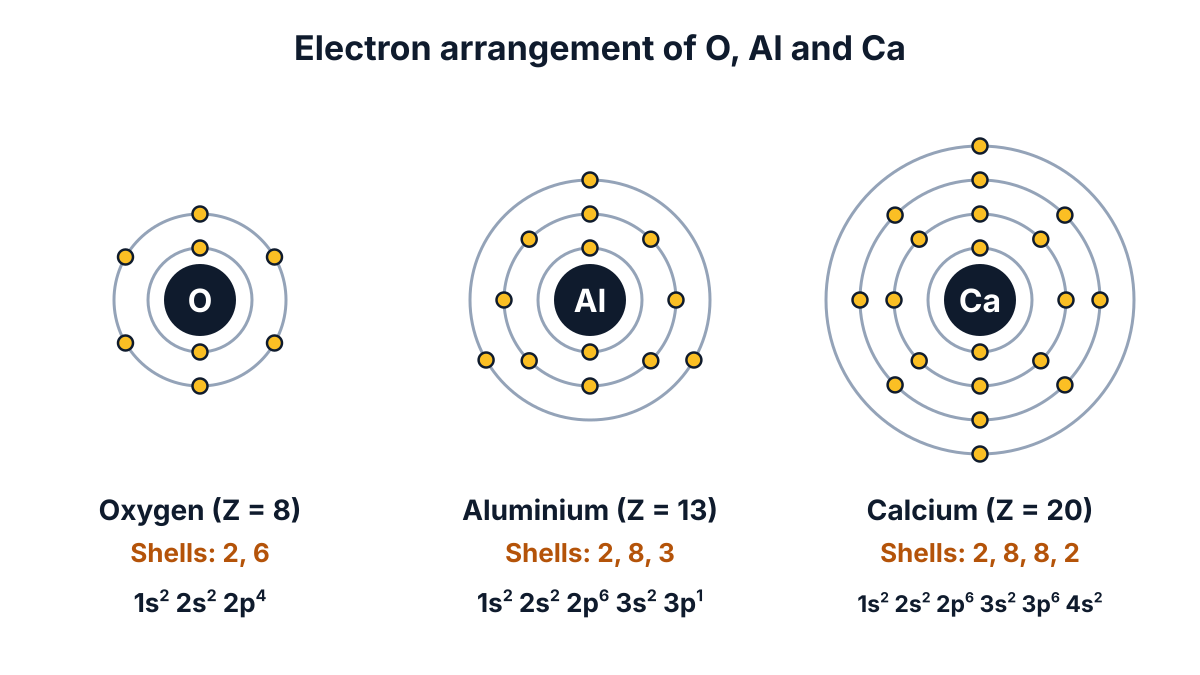
Figure: in calcium the 4s orbital fills before 3d, so the last two electrons go to the fourth shell.
Exam tip: for calcium, do not write 3d². The 4s orbital has lower energy than 3d, so it fills first.
Q3. Calculate the equivalent weight of HCl, NaOH and Na2CO3. (3 marks)
Equivalent weight = molecular weight ÷ (basicity of acid, acidity of base, or total positive valency of metal in a salt). Atomic weights: H = 1, C = 12, O = 16, Na = 23, Cl = 35.5 (from the basic concepts chapter).
- HCl: M = 1 + 35.5 = 36.5; basicity 1; E = 36.5 ÷ 1 = 36.5
- NaOH: M = 23 + 16 + 1 = 40; acidity 1; E = 40 ÷ 1 = 40
- Na₂CO₃: M = (2 × 23) + 12 + (3 × 16) = 106; valency factor 2 (two Na⁺); E = 106 ÷ 2 = 53
Answer: HCl = 36.5, NaOH = 40, Na₂CO₃ = 53.
Q4. Define pH. Calculate the pH of 0.001M HCl solution. (3 marks)
pH is the negative logarithm (base 10) of the hydrogen ion concentration in mol/L: pH = −log[H⁺]. As the equilibrium chapter shows, pure water at 298 K has pH 7.
Calculation:
- HCl is a strong acid, so it ionises completely: HCl → H⁺ + Cl⁻.
- [H⁺] = 0.001 M = 10⁻³ M.
- pH = −log(10⁻³) = 3.
Answer: pH = 3 (the solution is acidic).
Q5. Define conductor, insulator and electrolyte. (3 marks)
- Conductor: a substance that allows electricity to pass through it without any chemical change in it. Examples: copper, silver, aluminium, graphite.
- Insulator: a substance that does not allow electricity to pass through it. Examples: glass, rubber, wood, plastic.
- Electrolyte: a substance that conducts electricity in the molten state or in aqueous solution, by the movement of ions, and gets decomposed in the process. Examples: NaCl, HCl, CuSO₄ in water.
Key points to write: conductor (electrons flow, no chemical change); insulator (no flow); electrolyte (ions flow, chemical decomposition).
Q6. What is stress cell? Explain with an example. (3 marks)
A stress cell is a corrosion cell formed in a single metal when one part is under stress and another part is not. The stressed part (bent, hammered, riveted or cold-worked) has higher energy, so it acts as the anode and corrodes. The unstressed part acts as the cathode.
Example: in an iron nail kept in water, the head, the point and any bend corrode first: Fe → Fe²⁺ + 2e⁻.
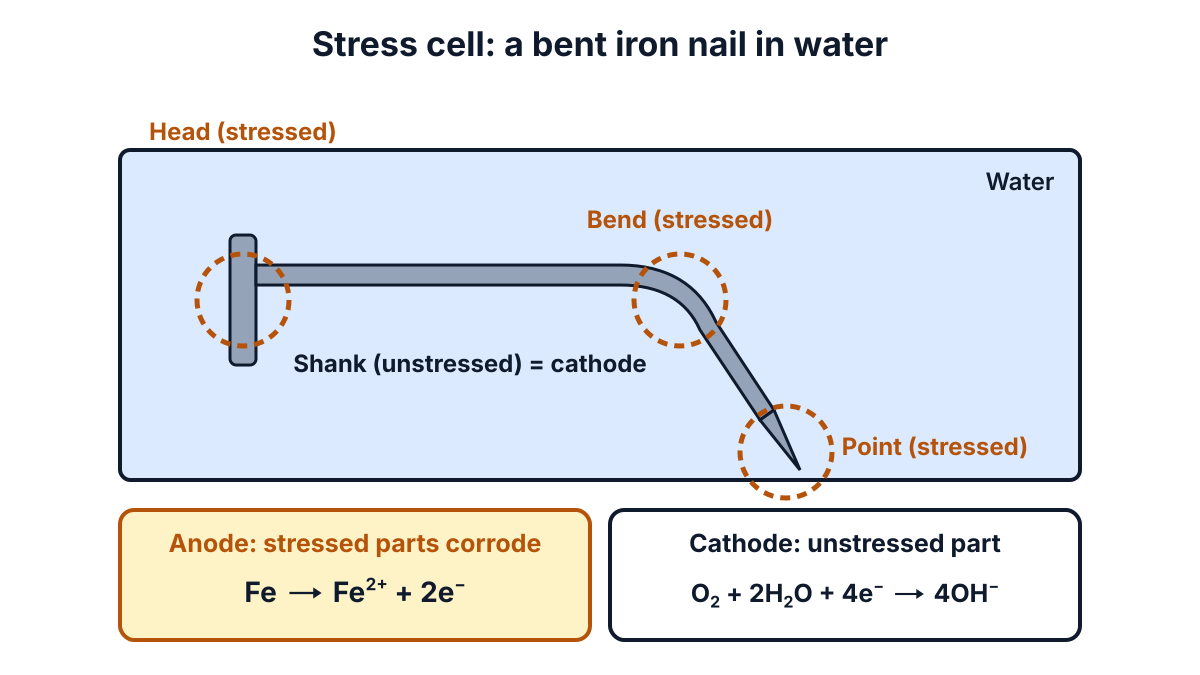
Figure: rust starts at the head, the bend and the point, the stressed parts of the nail.
Q7. Which salts are responsible for the hardness of water? (3 marks)
Hardness is caused by the dissolved salts of calcium and magnesium.
- Temporary hardness (removed by boiling): calcium bicarbonate Ca(HCO₃)₂ and magnesium bicarbonate Mg(HCO₃)₂.
- Permanent hardness (not removed by boiling): calcium chloride CaCl₂, magnesium chloride MgCl₂, calcium sulphate CaSO₄ and magnesium sulphate MgSO₄. Nitrates of Ca and Mg also add to it.
Key points to write: bicarbonates → temporary; chlorides and sulphates → permanent.
Q8. Define condensation polymerization. Give an example. (3 marks)
Condensation polymerization is the joining of monomers that carry two reactive functional groups, with the removal of a small molecule such as H₂O, HCl or NH₃ at each step. The polymer formula is not a simple multiple of the monomer.
Example: Nylon 6,6 is formed from hexamethylenediamine and adipic acid, with water removed:
n H₂N–(CH₂)₆–NH₂ + n HOOC–(CH₂)₄–COOH → [–NH–(CH₂)₆–NH–CO–(CH₂)₄–CO–]ₙ + 2n H₂O
Bakelite (phenol + formaldehyde) is another example.
Q9. What are primary fuels and secondary fuels? Give examples. (3 marks)
Fuels are classified by occurrence into two groups.
- Primary (natural) fuels occur in nature and are used as they are found. Examples: wood, coal (solid); crude petroleum (liquid); natural gas (gas).
- Secondary (derived) fuels are made from primary fuels by some processing. Examples: charcoal, coke (solid); petrol, kerosene, diesel (liquid); LPG, coal gas, producer gas (gas).
Key points to write: primary = found in nature; secondary = prepared from primary fuels.
Q10. Define dissolved oxygen, BOD and COD. (3 marks)
- Dissolved oxygen (DO): the amount of oxygen gas dissolved in water, in mg/L (ppm). Healthy water has high DO; polluted water has low DO.
- Biochemical oxygen demand (BOD): the amount of oxygen needed by microorganisms to oxidise the biodegradable organic matter in one litre of water, usually measured over 5 days. A higher BOD means more polluting water.
- Chemical oxygen demand (COD): the amount of oxygen needed to oxidise all the organic and inorganic matter in one litre of water chemically, using a strong oxidising agent such as acidified K₂Cr₂O₇.
Exam tip: COD is always higher than or equal to BOD, because the chemical oxidant also attacks matter that microbes cannot break down.
Q11. What are quantum numbers? Explain the significance of four quantum numbers. (10 marks)
Quantum numbers are a set of four numbers that give the complete address of an electron in an atom: its shell, subshell, orbital and spin. They are n, l, m and s.
1. Principal quantum number (n)
- Values: n = 1, 2, 3, 4 … (shells K, L, M, N).
- It gives the main energy level and the size of the orbit. As n increases, the electron is farther from the nucleus and has more energy.
- Maximum electrons in a shell = 2n². Example: n = 3 holds 18 electrons.
2. Azimuthal (subsidiary) quantum number (l)
- Values: l = 0 to (n − 1). For n = 3, l = 0, 1, 2.
- It gives the subshell and the shape of the orbital: l = 0 is s (spherical), l = 1 is p (dumbbell), l = 2 is d (double dumbbell), l = 3 is f.
- Subshells of the same shell differ slightly in energy: s < p < d < f.
3. Magnetic quantum number (m)
- Values: m = −l to +l, including 0, so there are (2l + 1) values.
- It gives the orientation of the orbital in space. s has 1 orbital, p has 3 (pₓ, p_y, p_z), d has 5, f has 7.
- It explains the splitting of spectral lines in a magnetic field (Zeeman effect).
4. Spin quantum number (s)
- Values: +½ (clockwise, ↑) or −½ (anticlockwise, ↓).
- It gives the direction of spin of the electron about its own axis.
- An orbital holds at most 2 electrons, with opposite spins.
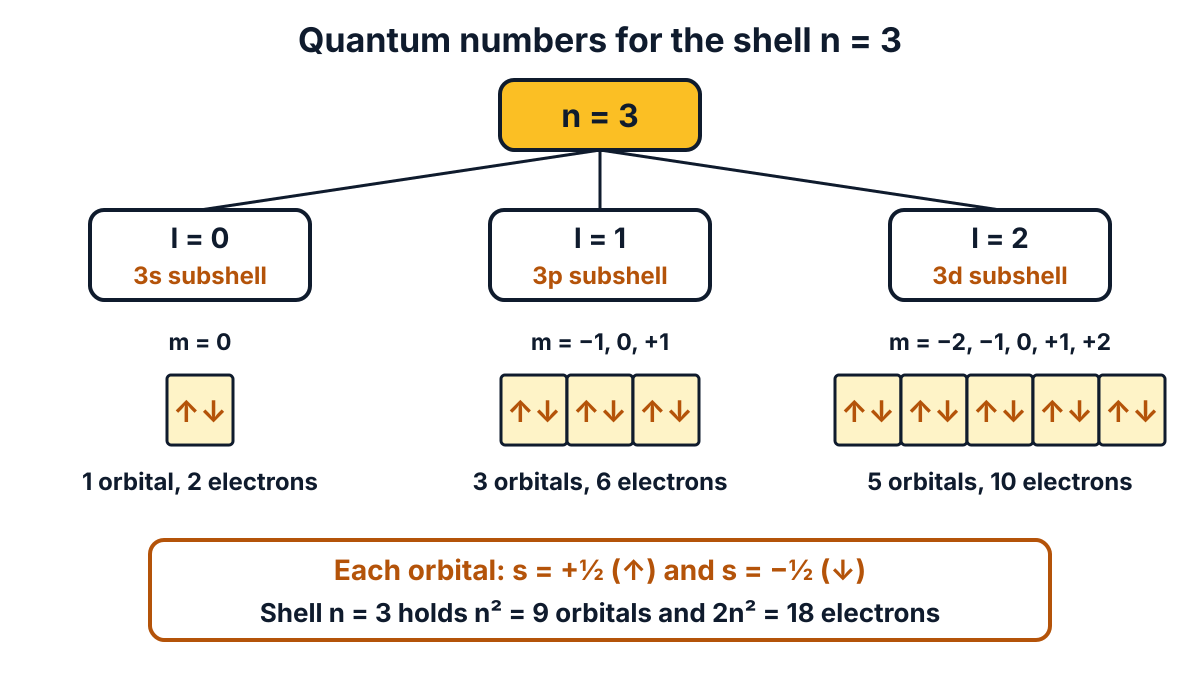
Figure: n fixes the shell, l the subshell, m the orbital and s the spin; together they give 9 orbitals and 18 electrons for n = 3.
Example: the last electron of sodium (3s¹) has n = 3, l = 0, m = 0, s = +½.
Significance in one line: by the Pauli exclusion principle, no two electrons in an atom can have the same set of all four quantum numbers, so each shell holds a fixed number of electrons. The structure of atom chapter gives the same rules for l and m.
Key points to write: n = size and energy; l = shape; m = orientation; s = spin; table of values; Pauli principle.
Q12. Explain the Arrhenius theory of acids and bases with examples. Give its limitations. (10 marks)
Arrhenius theory says that an acid gives hydrogen ions (H⁺) and a base gives hydroxyl ions (OH⁻) when dissolved in water. The theory is based on ionisation in aqueous solution.
Acid: a substance that gives H⁺ ions in aqueous solution.
- HCl → H⁺ + Cl⁻
- HNO₃ → H⁺ + NO₃⁻
- H₂SO₄ → 2H⁺ + SO₄²⁻
- CH₃COOH ⇌ CH₃COO⁻ + H⁺ (weak acid, partly ionised)
Base: a substance that gives OH⁻ ions in aqueous solution.
- NaOH → Na⁺ + OH⁻
- KOH → K⁺ + OH⁻
- Ca(OH)₂ → Ca²⁺ + 2OH⁻
- NH₄OH ⇌ NH₄⁺ + OH⁻ (weak base, partly ionised)
Strength: strong acids and bases (HCl, NaOH) ionise completely. Weak acids and bases (CH₃COOH, NH₄OH) ionise only partly.
Neutralisation: an acid and a base react to form salt and water. The real reaction is H⁺ + OH⁻ → H₂O. Example: HCl + NaOH → NaCl + H₂O.
Limitations of the Arrhenius theory (the equilibrium chapter names the first two):
- It applies only to aqueous solutions. It cannot explain acid-base behaviour in other solvents such as liquid ammonia.
- It cannot explain the basic nature of NH₃ and Na₂CO₃, which have no OH group of their own.
- It cannot explain the acidic nature of CO₂, SO₂ and AlCl₃, which have no hydrogen to give.
- A free H⁺ ion cannot exist in water. It joins a water molecule to form the hydronium ion, H₃O⁺.
- It cannot explain neutralisation without water, such as NH₃(g) + HCl(g) → NH₄Cl(s).
Key points to write: acid → H⁺ in water; base → OH⁻ in water; two equations each; neutralisation H⁺ + OH⁻ → H₂O; at least four limitations.
Q13. (a) Write any five differences between Ionic and Covalent compounds. (b) Define normality and find the water to be added to 250 ml of 0.05 N Na2CO3 to make it 0.01 N. (10 marks)
(a) Ionic vs covalent compounds (5 marks)
Ionic compounds form by transfer of electrons and build crystal lattices; covalent compounds form by sharing of electrons, as described in the chemical bonding chapter.
| Property | Ionic compounds | Covalent compounds |
|---|---|---|
| Bond formation | Transfer of electrons | Sharing of electrons |
| Physical state | Hard crystalline solids | Gases, liquids or soft solids |
| Melting and boiling points | High | Low |
| Solubility | Soluble in polar solvents like water | Soluble in non-polar solvents like benzene |
| Electrical conductivity | Conduct in molten state or in water | Do not conduct (non-electrolytes) |
| Reactions | Fast (ionic reactions) | Slow (molecular reactions) |
| Example | NaCl | H₂, CH₄ |
(b) Normality and dilution (5 marks)
Normality (N) is the number of gram equivalents of solute dissolved in one litre of solution. N = (weight of solute ÷ equivalent weight) × (1000 ÷ volume in ml).
Given: N₁ = 0.05 N, V₁ = 250 ml, N₂ = 0.01 N. Find V₂, then the water to add.
- Dilution formula: N₁V₁ = N₂V₂ (gram equivalents do not change on adding water).
- 0.05 × 250 = 0.01 × V₂
- 12.5 = 0.01 × V₂
- V₂ = 12.5 ÷ 0.01 = 1250 ml
- Water to be added = V₂ − V₁ = 1250 − 250 = 1000 ml
Answer: add 1000 ml (1 litre) of water to make 1250 ml of 0.01 N Na₂CO₃.
Exam tip: the question asks for the water to be added, not the final volume. Writing 1250 ml as the answer loses marks.
Q14. (a) Explain electrolysis of fused NaCl with a neat diagram and relevant chemical equations. (b) Write any four differences between metallic and electrolytic conduction. (10 marks)
(a) Electrolysis of fused NaCl (6 marks)
Electrolysis is the chemical decomposition of an electrolyte, in molten state or in solution, by passing direct current through it. Fused (molten) NaCl is used so that only Na⁺ and Cl⁻ ions are present.
Steps:
- Solid NaCl is heated until it melts. In the melt it is fully ionised: NaCl → Na⁺ + Cl⁻.
- Two electrodes dip into the melt: an iron cathode joined to the negative terminal of a DC source and a graphite anode joined to the positive terminal.
- On passing current, Na⁺ ions move to the cathode and Cl⁻ ions move to the anode.
- At the cathode (reduction): Na⁺ + e⁻ → Na. Liquid sodium metal collects.
- At the anode (oxidation): 2Cl⁻ → Cl₂ + 2e⁻. Chlorine gas is given off.
- Overall: 2NaCl → 2Na + Cl₂.
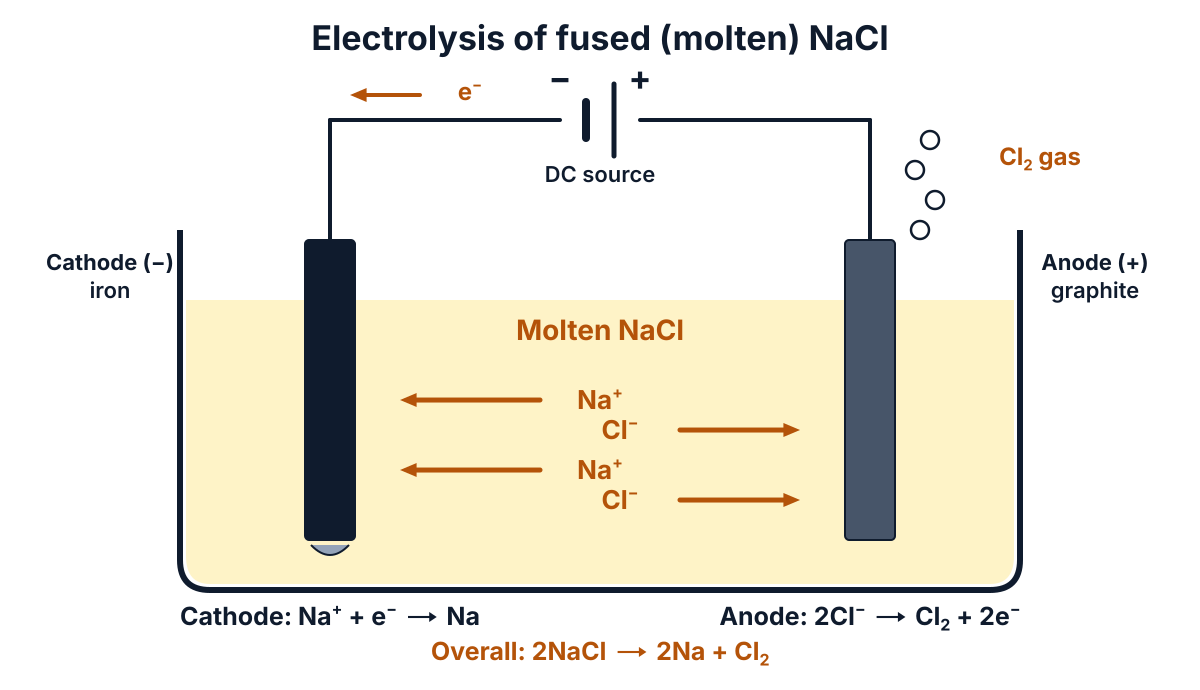
Figure: positive Na⁺ ions go to the negative cathode and form sodium; Cl⁻ ions go to the positive anode and form Cl₂.
The electrochemistry chapter confirms that molten NaCl gives sodium at the cathode and chlorine at the anode. In aqueous NaCl, hydrogen forms at the cathode instead, which is why the melt is used.
(b) Metallic vs electrolytic conduction (4 marks)
| Metallic conduction | Electrolytic conduction |
|---|---|
| Current is carried by free electrons | Current is carried by ions |
| No chemical change in the conductor | The electrolyte decomposes (chemical change) |
| No transfer of matter | Matter moves as ions to the electrodes |
| Resistance increases, so conduction decreases, with rise in temperature | Conduction increases with rise in temperature |
| Example: copper, silver | Example: molten NaCl, CuSO₄ solution |
Q15. Explain sacrificial anode and impressed voltage methods of prevention of corrosion. (10 marks)
Both methods are forms of cathodic protection: the metal to be protected is forced to act as the cathode, so it does not lose electrons and does not corrode.
1. Sacrificial anode method
- The iron or steel structure (buried pipeline, ship hull, water tank) is connected by an insulated copper wire to a block of a more active metal, such as magnesium, zinc or aluminium.
- The active metal has a more negative electrode potential, so it becomes the anode and corrodes: Mg → Mg²⁺ + 2e⁻.
- The electrons flow through the wire to the iron, which becomes the cathode and is protected.
- The anode is “sacrificed”. When it is used up, it is replaced with a new block.
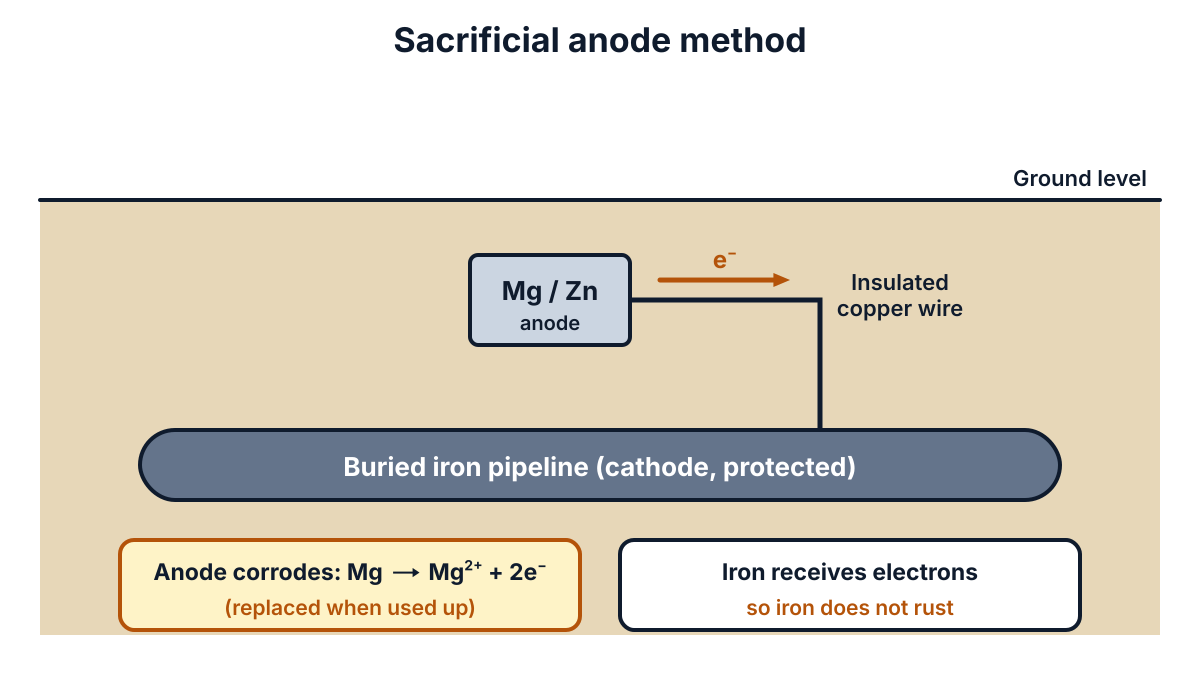
Figure: the Mg or Zn block corrodes in place of the iron pipe and is replaced when consumed.
Uses: underground pipelines and cables, ship hulls, marine structures, and Mg rods inside domestic water heaters and storage tanks. The electrochemistry chapter lists Mg and Zn as such sacrificial electrodes.
2. Impressed voltage (impressed current) method
- A direct current from an external source (battery or rectifier) is applied against the corrosion current.
- The negative terminal is joined to the structure to be protected, so it becomes the cathode.
- The positive terminal is joined to an insoluble anode such as graphite, high-silicon iron or scrap iron, buried in the soil.
- The anode is packed in a backfill of coke, gypsum and bentonite, which improves electrical contact with the soil.
- The applied voltage keeps pushing electrons into the structure, so it does not corrode.
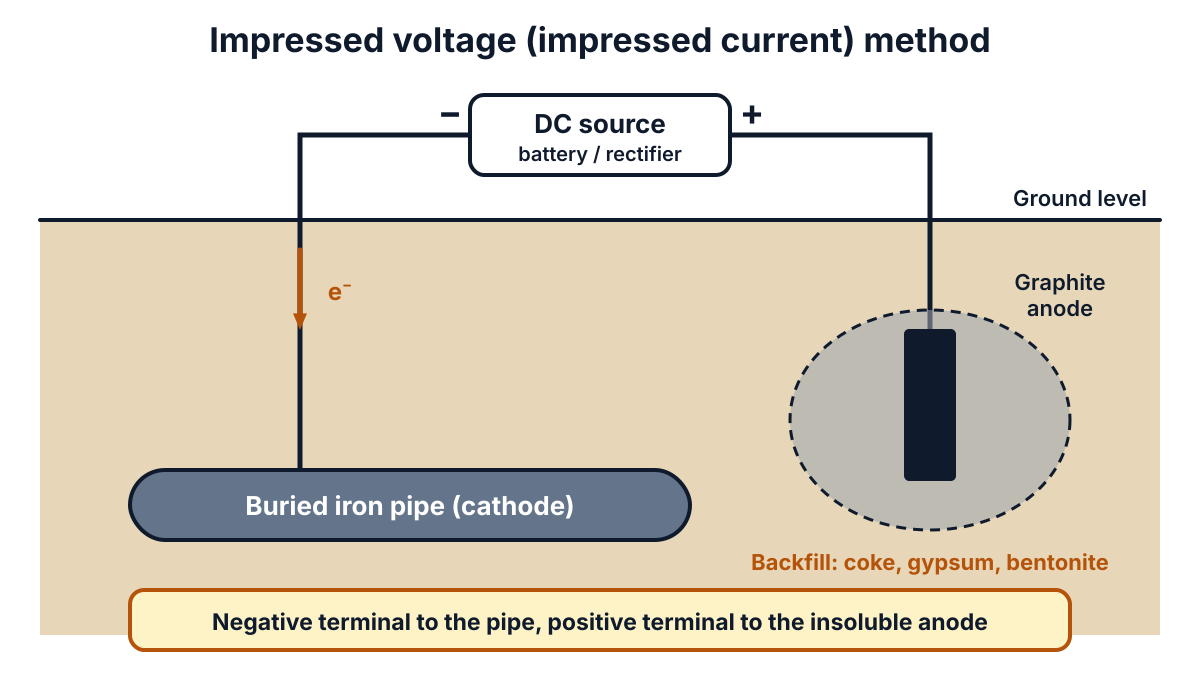
Figure: the external DC source makes the pipe the cathode; the graphite anode in backfill completes the circuit through the soil.
Uses: long buried pipelines, underground water and oil tanks, transmission line tower bases and marine piers.
| Point | Sacrificial anode | Impressed voltage |
|---|---|---|
| Source of electrons | Corrosion of active metal | External DC source |
| Anode | Mg, Zn, Al (consumed) | Graphite, scrap iron (insoluble) |
| Running cost | Anode replacement | Electricity |
| Best for | Small or medium structures | Large structures, long pipelines |
Key points to write: principle of cathodic protection; both diagrams; Mg → Mg²⁺ + 2e⁻; backfill; two uses each.
Q16. (a) Calculate the temporary and permanent hardness of a water sample containing Ca(HCO3)2 40.5 ppm, Mg(HCO3)2 36.5 ppm, CaSO4 34 ppm and MgSO4 30 ppm. (b) Write any four disadvantages of using hard water in industries. (10 marks)
(a) Hardness calculation (6 marks)
Hardness is expressed as CaCO₃ equivalents, because CaCO₃ has molar mass 100 and is the standard. 1 ppm = 1 mg/L.
Formula: CaCO₃ equivalent = (amount of salt × 100) ÷ molar mass of the salt.
Molar masses (Ca = 40, Mg = 24, H = 1, C = 12, O = 16, S = 32): Ca(HCO₃)₂ = 162, Mg(HCO₃)₂ = 146, CaSO₄ = 136, MgSO₄ = 120.
| Salt | Amount (ppm) | Molar mass | CaCO₃ equivalent (ppm) | Type |
|---|---|---|---|---|
| Ca(HCO₃)₂ | 40.5 | 162 | 40.5 × 100 ÷ 162 = 25 | Temporary |
| Mg(HCO₃)₂ | 36.5 | 146 | 36.5 × 100 ÷ 146 = 25 | Temporary |
| CaSO₄ | 34 | 136 | 34 × 100 ÷ 136 = 25 | Permanent |
| MgSO₄ | 30 | 120 | 30 × 100 ÷ 120 = 25 | Permanent |
- Temporary hardness = 25 + 25 = 50 ppm
- Permanent hardness = 25 + 25 = 50 ppm
- Total hardness = 50 + 50 = 100 ppm
Answer: temporary hardness = 50 ppm, permanent hardness = 50 ppm (total 100 ppm, as CaCO₃).
Exam tip: bicarbonates go to temporary hardness; sulphates and chlorides go to permanent hardness. Do not add the raw ppm values of the salts; convert each to CaCO₃ first.
(b) Disadvantages of hard water in industries (4 marks)
- Boilers: hard water forms scale and sludge on boiler walls. Scale is a poor conductor of heat, so fuel is wasted, tubes overheat and may burst. It also causes priming, foaming and caustic embrittlement.
- Textile and dyeing: Ca and Mg salts react with soap and dyes, giving uneven colours and spots on cloth.
- Sugar industry: dissolved salts make crystallisation of sugar difficult and the sugar may become deliquescent.
- Paper industry: Ca and Mg salts reduce the gloss and smoothness of paper.
- Laundry: much soap is wasted as insoluble scum, and clothes get stained.
Q17. (a) Write a method of preparation and two uses of (i) Buna-S and (ii) Neoprene rubber. (b) Define Nanomaterials. Write any two examples and applications. (10 marks)
(a) Buna-S and Neoprene (6 marks)
(i) Buna-S (styrene-butadiene rubber, SBR)
- Preparation: Buna-S is a copolymer. 1,3-butadiene and styrene (in about 3 : 1 ratio) are copolymerised in an emulsion in the presence of a peroxide catalyst (sodium was the original catalyst, which gives the “Na” in the name).
- n CH₂=CH–CH=CH₂ + n C₆H₅–CH=CH₂ → [–CH₂–CH=CH–CH₂–CH₂–CH(C₆H₅)–]ₙ
- Uses: motor tyres, shoe soles, floor tiles, conveyor belts, cable insulation.
(ii) Neoprene (polychloroprene)
- Preparation: chloroprene (2-chloro-1,3-butadiene) undergoes addition polymerisation in the presence of a free-radical initiator.
- n CH₂=C(Cl)–CH=CH₂ → [–CH₂–C(Cl)=CH–CH₂–]ₙ
- Uses: oil seals, gaskets, hoses and conveyor belts (it resists oil and petrol), and insulation of electric wires and cables.
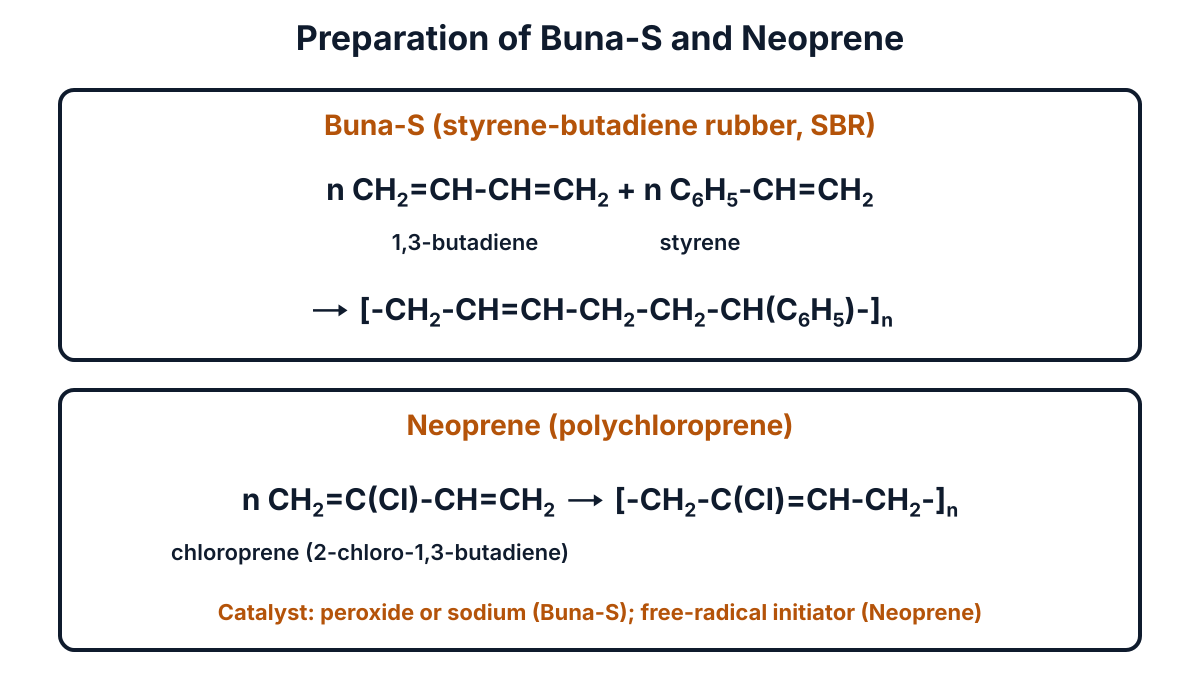
Figure: Buna-S is a copolymer of two monomers; Neoprene is a homopolymer of chloroprene.
(b) Nanomaterials (4 marks)
Nanomaterials are materials in which at least one dimension is in the nanoscale, about 1 to 100 nanometres. At this size they show new properties such as very high surface area, high strength and special optical and electrical behaviour.
Examples: carbon nanotubes, fullerenes (C₆₀), graphene, silver nanoparticles, TiO₂ and ZnO nanoparticles.
Applications:
- Electronics: smaller transistors, memory chips and sensors.
- Medicine: targeted drug delivery and antibacterial (silver) coatings.
- Energy: better battery electrodes and solar cells.
- Consumer goods: TiO₂ and ZnO in sunscreens; stronger, lighter sports goods.
Q18. (a) What are renewable and non-renewable sources of energy? Give examples. (b) Write any four principles of green chemistry. (10 marks)
(a) Renewable and non-renewable energy (6 marks)
Renewable sources of energy are those that are replaced by nature continuously and will not run out with use. They cause little pollution.
Non-renewable sources of energy are those formed over millions of years and available in limited stock. Once used, they cannot be replaced in a human lifetime, and most of them pollute the air.
| Renewable | Non-renewable |
|---|---|
| Solar energy | Coal |
| Wind energy | Petroleum (crude oil) |
| Hydro (water) power | Natural gas |
| Tidal and wave energy | Nuclear fuels (uranium) |
| Geothermal energy | Lignite |
| Biomass and biogas |
Key points to write: renewable = replenished by nature, inexhaustible, clean; non-renewable = limited stock, exhaustible, polluting; four examples each.
(b) Principles of green chemistry (4 marks)
Green chemistry is the design of chemical products and processes that reduce or remove the use and production of hazardous substances. Any four of the twelve principles:
- Prevent waste: it is better to prevent waste than to treat or clean it up later.
- Maximise atom economy: the final product should contain as much of the starting materials as possible.
- Use safer solvents and reaction conditions: avoid harmful solvents; use water or safer ones.
- Increase energy efficiency: run reactions at room temperature and pressure where possible.
- Use renewable feedstocks: use raw materials from plants and wastes instead of petroleum.
- Use catalysts: catalysts work in small amounts and reduce waste.
- Design for degradation: products should break down into harmless substances after use.
FAQ
Which Part B questions are easiest to score in the EE-104 March 2025 paper?
Q16 (hardness sum plus disadvantages of hard water) and Q13 (ionic vs covalent table plus a dilution sum) are the safest, because the numbers work out exactly: 50 ppm temporary, 50 ppm permanent and 1000 ml of water. Q14 and Q15 are next if you can draw the cells.
Which units carry the most marks in this Engineering Chemistry paper?
Unit 1 (atomic structure and bonding) and Unit 2 (solutions, acids and bases) together give four Part A questions and three Part B questions. The C-23 syllabus also gives these two units the highest weightage, 21 marks each.
How do you calculate temporary and permanent hardness from salt amounts in ppm?
Convert each salt to its CaCO₃ equivalent: amount × 100 ÷ molar mass of the salt. Add the bicarbonates for temporary hardness and the sulphates and chlorides for permanent hardness. Total hardness is the sum of both.
Are these the official SBTET answers?
No. These are model answers written from the C-23 syllabus and its prescribed books. SBTET does not publish an answer key, and this site is not linked to SBTET AP.
Sources
- AP SBTET C-23 DEEE EE-104 question paper, Mar-Apr 2025
- C-23 Curriculum, Diploma in Electrical and Electronics Engineering, SBTET AP
- Prescribed textbook: Intermediate Chemistry Vol. 1 & 2, Telugu Academy
- Reference books (C-23 syllabus):
- Jain & Jain: Engineering Chemistry
- O.P. Agarwal: Engineering Chemistry, Hi-Tech
- D.K. Sharma: Engineering Chemistry
- A.K. De: Engineering Chemistry
- Class 11 Chemistry, Some Basic Concepts of Chemistry
- Class 11 Chemistry, Structure of Atom
- Class 11 Chemistry, Chemical Bonding and Molecular Structure
- Class 11 Chemistry, Equilibrium
- Class 12 Chemistry, Electrochemistry
- Class 12 Biology, Microbes in Human Welfare
- National Nanotechnology Initiative: About Nanotechnology
- US EPA: Basics of Green Chemistry
Writes and reviews the SBTET EEE Papers solutions: AP SBTET diploma question papers answered step by step from the prescribed syllabus.